
13. July 2016 | Blog
A big part of the experience when joining a Refuga trip, is the other participants on the trips. That’s why we want to showcase some of the participants who joined us. This time we have talked to Adam Blicher, who is a young, talented Tennis Coach with big dreams.
Adam joined our trip to Kilimanjaro a few years ago and he impressed us big time. We’re not tennis nerds (personally, I actually don’t know the rules of the game), but Adam has many great insights into performance and in living differently. He is just 25 years old now, but traveling full-time while making a living coaching young people.
Tell us a bit about yourself? What do you do, where do you come from, age, education etc.?
In my everyday work I first and foremost try to enhance the quality of life of the Tennis Players that I’m working with. Second, I use the stress & demands of Tennis to help them build character on their Tennis Journey. Third, I assist them in understanding how they function as human beings & what they need to do in order to be in their optimal performance state when they are competing against children from other countries trying to climb the international rankings.
I graduated a couple of weeks ago with a Masters in Sport Psychology from the University of Southern Denmark & turned 25 a couple of days later.
How did you get started with Tennis?
I started playing tennis by coincidence. When I was 5 my dad was at a meeting in the local tennis club where I was accompanying him. I was handed a racquet & a foam ball & started hitting against the wall. Instantly thought it was funny, but at the time there were no children my age playing in the club so it wasn’t until the year after I actually started playing.
When did you decide to focus on coaching?
In the club I grew up in it was a tradition that you helped out as an assistant coach from a young age a couple of hours a week, so I have basically been coaching since the age of 12. It wasn’t though until the end of High School that I decided that I wanted to pursue coaching full time & make a living out of it – so by the age of 18.
Your work is both on the court coaching, but you’re also an entrepreneur. How does your work life look like (fx a normal day or month)?
I hate to give a vague answer like “it depends”, but it really does & I guess the flexibility & variety that I have had in my everyday life during the past 5 years has suited me tremendously well.
I’m very bad at working on multiple projects at once so I focus only on 1 project at a time. I like to take several days at a time where everything I do besides eating, exercising & sleeping is centered around the same specific task/project. As I have done a lot of consulting for the Danish Tennis Association there are periods of time where I’m behind my computer no matter where I’m geographically located in the world.
Approximately 15 weeks a year I’m traveling to foreign tennis tournaments & Coaching Conferences where I rise early & log a couple of hours work before breakfast & then again after dinner.
The past 5 years I have used 2 weeks every semester exclusively on my studies, making sure that I gained the necessary knowledge & was able to pass my exams & then the rest of the year just occasionally attending lectures when it suited into my schedule.
Furthermore I at least go for 1 Internship a year on a Tennis Academy in order to learn from more experienced & accomplished coaches than myself.
At last I have weekly Skype Consultations with National & International Tennis Players working on the mental aspect of tennis. This has been a constant source of income that has covered the costs of my Podcast, the social media marketing I have been doing & made it possible for me to go on the non-paid internships the past couple of years.
I was the trip leader on the Kilimanjaro when you joined and I must say, I have never met anyone as young as you with as much insights into personal development and performance. Can you share one of the biggest lessons you’ve learned your self working with so many talented people?
First of all thank you!
I think I have been good at seeking out opportunities where I have been the youngest & less experienced person in a lot of different situations. At the same time I’m probably using ¼ of my time working for free, clearing the path for people above me in the ladder who are doing the things that I aspire to. Basically I’m trying to add value & create a better & easier life for the people that do what I want to do in the future. That has benefitted me tremendously & I have learned my biggest life lessons from those people.
The most valuable lesson for me has been replicated several times throughout my life. The first time I took notice, but probably didn’t understood it, was when my big brother gave me Stephen Covey’s “7 habits of highly effective people. The 5th habit Stephen talks about is called seek first to understand, then to be understood.
Later on in my life on my Master Coach Education I learned about how everyone interprets the exactly same situation differently. At last the most influential person in my life, besides my parents, Erik W. Petersen, has taught me to respect other people’s way of life. To never judge another person & try to decide what is right or wrong for him/her, when it sometimes can be hard to do that even for yourself.
So in my everyday life & work I always try to let others talk first. To be curious when there is something that I don’t understand, keep asking questions until I get a grasp of meaning & then no matter whether I understand it or not help the other person to understand my point of view without judging who is right & who is wrong.
You have taken a quite different career path than others your age. Have you had any challenges doing that?
I think everyone who is as snobbish as I am not settling for anything less than exactly what I want will meet challenges & face resistance. Sometimes I actually think that it is easier creating a different career path simply because there is less competition. I am very aware that the challenges & struggles are something that I have chosen to endure myself. If one day I do not want those struggles anymore I can just choose to settle for less. I think the struggles is a natural part of what I do & without the hardship & lessons learned on my path I do not think that I would appreciate reaching the goals as much as I do.
When taking a different career path you have to define the path yourself and it’s often very difficult to just follow in the footsteps of others. How did you and how do you decide which way to go?
Whenever I’m thinking about a new project I’m trying to think about how the project will help me separate from the masses of tennis coaches. How it can help create the story about me as the first to do x or if someone has already done what I’m going to do, make a slight twist to the project in order to separate myself.
I get a lot of inspiration following coaches from other sports such as John Wodden, Nick Levett & Gary Curneen & then I think that I have been fortunate to meet a lot of inspirational people throughout my life that have inspired me.
How did you find Refuga in the first place?
I have followed a danish entrepreneur called Martin Thorborg for the past 10 years or so & at some point Nikolaj’s homepage & his book called “Better” popped up. The book looked interesting but had just sold out, so he offered the book for free on PDF if you signed up for his newsletter. I normally hate newsletters so I was a bit hesitant to do it, but I thought what the h… & signed up. The book was great so Nikolaj gained a lot of trust from me right there & then maybe a week or a couple of weeks later I received the first newsletter. Because of the high quality book that Nikolaj wrote I paid attention to the newsletter & saw that a trip to Kilimanjaro was advertised & you could apply for a spot.
What made you decide to join us in climbing Kilimanjaro?
My initial thoughts were that I wanted to meet this Nikolaj dude & if he chose who was able to go on the trip there would probably be some other very interesting persons on the trip as well. Besides that I had never been to Africa & I had definitely never climbed a mountain before. So I decided that even if Nikolaj & the other participants turned out to be complete douche bags I would at the very least experience a part of Africa & have climbed the highest freestanding mountain in the in the world.
I then applied for a spot on the trip. The only challenge was that I didn’t have the money to participate on the trip, but that’s typically how I approach my life. I figure out what I want to do, how I would benefit from it & then find a way to make it happen. In this instance Nikolaj was very nice to me & made it possible for me to pay in a couple of portions. Thanks, Niko 😉
Tell us a bit about the experience in Tanzania?
First & foremost I think the group of people that Nikolaj gathered would have had a terrific time no matter where we would have been & what we were doing, no doubt.
It was an amazing experience for me to have 7 days without my phone, my laptop & the internet. Nobody was able to reach me & I didn’t have the opportunity to reach anyone else than the group unless an emergency happened. Being completely offline made a huge impression on me & as a direct consequence I changed my social media habits when I got home. So instead of checking my feeds several times every single day I’m only checking facebook, instagram, Linkedin & my mail on wednesdays & sundays. Admittedly I sometimes cheat, but I haven’t missed out on anything as a consequence of my reduced notification checking & have only had a couple of people reacting negatively towards me about my habit changes over the span of 2 years.
I also lived for a couple of months without internet in my apartment & changed my smartphone to an old one, but both were to extreme for me. I got back the internet in my apartment & my smartphone, but I haven’t installed my mail, facebook or twitter on my phone, which has also made it easier for me not to binge check my social media accounts simply because I haven’t got the opportunity.
To sum up – probably the biggest lesson for me was due to the offline experiments that I did afterwards. I have come to realize that oftentimes my level of satisfaction is increased if I limit my opportunities. If I have too many opportunities & things that I can do I will no matter what I choose be a little unsatisfied & doubt whether one of the other possibilities would have been better / more fun / created more value.
Are you still in contact with some of the other participants from the trip and how would you characterize those relationships?
To think that everyone you meet on a Refuga trip is instantly going to be your new best friends & your business is going to skyrocket without paying any of the other participants a dime for their advice/work is of course not going to happen.
Some of the relations created on the mountain where absolutely fantastic. In a few cases I did though figure out when I got back home that the magic of the relation probably was that we didn’t have any alternatives. BUT, when that is said there is no doubt that I generated friends for life (hopefully they agree). I celebrated New Years last year with several of the participants & several of them was on the shortlist for my birthday party.
Besides the friends gained I think I have gotten some of the most valuable hands on, concrete advice and mentoring on how to develop my business/brand by some of the fellow participants by phoning or writing to them. At multiple occasions I have presented ideas for the other participants & said that I would be happy to pay them their hourly salary for their help/advice/expertize, but EVERY single time they have denied & added loads of value to me.
At last I think that the Refuga community that Nikolaj has created is fantastic to be a part of. I haven’t used it too the degree that it deserves & to be honest I probably should add more value to the community than I do at this point in time, but the amount of help & trust that I have witnessed that the community members offer each other is truly unique.
You have created a very popular podcast. Can you tell us a bit about it and what it has given you?
Before I start every project I ask myself:
- What will I gain from doing this project?
- What specific actions do I have to do?
- How much work/struggle/resouces is it worth to me?
- What is the worst result that I will be satisfied with?
- If the project completely fails – How will that negatively impact me?
- How can I get back to status quo in case the project fails?
- What actions can I take to minimize the risk of the project failing?
My answer to question 4 for the Podcast was/is:
Learn & improve as a tennis coach by getting a more in-depth understanding of high performance in tennis
Build & maintain long-lasting relationships to thought leaders within the world of tennis.
The reason why I have used space to explain the above is that I always think it’s very tough to determine whether other people are successful doing what they are doing because we often have no clue what their objectives are. For me the 2 parameters above are my objectives & success criteria.
The listener count & the fact that the Podcast hit the “New & Noteworthy” category within 2 weeks of publication has been an absolutely fantastic bonus & something that I only fantasized about.
Regarding the first 2 criteria I have:
- Learned how to periodize physical & on court training on the Professional Tour
- Learned how to beat jet lag, dehydration & cramps
- Learned how it’s possible to create a Team Environment in an individual sport
- Learned how to develop the players from their personality
- Learned how to use match statistics to better prepare players for upcoming opponents
- Received a job offer from one of the persons interviewed on the Podcast
- Been Invited & attended a Tennis Conference as a special Guest
- Been on Skype Calls & added to What’s App Conversations with people I consider thought leaders within tennis
- Visited & learned from one of the best Coaches in the industry
- Been invited to join one of the top male tennis players training sessions & meet the staff
Do you have any long term goals that you’re working towards?
I’m generally very interested in people who choose alternative paths in lives. They usually have a great mentality, spirit and a belief in themselves. I’m even more impressed when it’s young people, like yourself.
The ultimate goal for me is to eventually get an opportunity to go on the professional Senior Tour with either a male or a female player. I’m definitely best at coaching girls, no doubt – so the Women’s tour is 1st priority & where I think I can create most value.
The irony of the goal is that even if I’m lucky enough to have the opportunity to eventually go on tour it might not present itself for another 10 years at which point I would prioritize having a family & kids over traveling 30-35 weeks a year with a player on the tour.
On a daily basis besides evolving as a human being & a tennis coach I’m working towards creating a personal brand within the world of tennis. To continually make projects like the Podcast that can positively contribute to the world of tennis no matter whether it’s a book, an e-course or the christmas calendar for tennis players that I have in mind.
I strive to one day make it possible to one day be geographically independent. Be able to stay remotely & not be tied to one single place. This goal might very well change when I hopefully one day create a family & have kids, but at the moment it’s a big priority of mine.
Do you have any advice on living differently and taking an alternative career path to other young people?
I often times think that people who have a lot are afraid of losing what they already have. Which means that they live with an extremely defensive mindset. Always trying to protect what they have already achieved, trying to avoid tough situations & working extremely hard to achieve something, risking that they will fail. In other words never getting out of their comfort zone.
Being born in Denmark we are incredibly privileged, to an extend that is hard to grasp. Something that has proven very evident for me during the past 5 years traveling to 20+ countries. I believe that your life shrinks & expands according to the level of your courage. Sometimes my courage is bigger than my abilities, no doubt! But as a danish citizen I will always get picked up if I fail either by family, friends or in the last instance the system. It gives me an extreme security to know that no matter how much I screw up I can always go back & have a normal 8am-4pm job & have a decent life.
Do I think that everyone should aspire to live the life that I’m doing, absolutely not. In long periods of time I’m neglecting my family & friends, sometimes I forget about my own health & get caught up in my work to an extent where the only thing that makes me stop is when my body tells me to relax & I get sick. I often ask myself whether it is all worth it, but as long as what I can achieve is more valuable to me than what I have to go through/sacrifice I’m going to continue down the same path.
Do I think that more people should strive to take an alternative career path & try to design the life that they truly want with all the hardship that it takes, absolutely YES.
If we are not talking Tennis specific stuff, but more generally, like performance and entrepreneurship, where do you go to for inspiration and learning new stuff?
I have been very inspired by Tim Ferriss & pretty much followed everything he has done since he wrote the 4 Hour Work Week. His Podcast was a defining factor in my decision to start my own Podcast where it is my quest to dissect high performance in Tennis by talking to different experts.
Pretty much all of my entrepreneurship inspiration stems from persons I have heard on The Tim Ferriss show or read about in his blog posts.
I think Derek Sivers (episode #125) is probably the single best Podcast episode that I have ever listened to. He is amazingly aware of what is important to him & how we wants to live life. Very clever in the way he goes about his life.
I follow Ryan Holliday & have read his 2 books that I really like “The Obstacle is the way” & “Ego is the enemy”. The first book about handling the uncontrollable events that happens outside of you, whereas the recent book is about the internal struggles we experience as human beings.
Austin Kleon’s books “Steal Like an Artist” & “Show your work” has made me understand how I can create a relation to my audience even before I have a product to sell. I try to share a little piece of my work each & every day on one of my social media platforms. Furthermore Ryan Holiday’s article about how he uses “Common Place Notes” has served as the method I use to store notes from the books I read, the podcasts I listen & the social media posts that inspires me. All together my Common Place Note functions as the place I go everytime I fill up my buffer with Tweets, Facebook- & Linkedin updates.
Building my personal brand & understanding how to position myself among my fellow coaching colleagues, I have gained a lot of inspiration reading “22 immutable Laws of Marketing” by Al Ries & Jack Trout. I know absolutely nothing about marketing, but I do think I learned a lesson or two reading that book, or at least I’d like to think so.
Regarding high performance I’m extremely fascinated by Joshua Waitzkin who was a chess prodigy as a child & later became World Champion in Tai Chi Push Hands. He is now helping the top 1 % of performers in the business world & has laid out his training principles in his book “The art of learning”.
Russ Harriss has to a large degree inspired how I consult the players that I’m working with on the mental part of life & tennis. He is a psychologist that have specialized & written several books on ACT (Acceptance & Commitment Therapy). He writes in an easy to understand everyday language & has even made a pixie book that explains the basic principles of the evidence based Therapy form, ACT.
At last I have been very inspired by the way that you, Nikolaj have managed to design your own life & travel the world while working. Including that inspiration I gained from you I think Rolf Potts’ book “Vagabonding” was a deciding factor for me 4-5 years ago in the way that I have tried to organize my life & travel 15ish weeks a year while studying at the same time.
Where can we find you online?
I think you should only follow me if you are a tennis fanatic otherwise you will drown in tennis related stuff as that’s just about everything that I post on each & every social media platform.
My Personal Website is www.adamblicher.com – Consider it more of an online business card
My instagram handle is @adamblicher where you’ll find pictures & short videos from every time I go on foreign trips with tennis players.
My Snapchat handle is @adamblicher – A look behind the scenes whenever I’m at training camps, tournaments, Coaching Conference or other tennis related events.
My facebook page, which you can find @adamblichercoaching is first & foremost a platform where I share coaching ideas of mine with fellow coaches
My podcast is on Itunes & is called “The Adam Blicher Show: Dissecting High Performance in Tennis”. You can find it either by searching in the Podcast App on your Iphone or downloading the app called Stitcher if you are using an Android Smartphone.
Adam, thanks for taking the time to answer these questions. Personally, I’m really looking forward to following your career going forward.
Thanks, Niko – Like wise! 🙂

29. June 2016 | Blog
Bala is born in India, but have been living and working in Silicon Valley in California for many years. In 2015 we had the great pleasure of having Bala on our trip to Russia, where we climbed the highest mountain of the european continent, Mount Elbrus. He just signed up for our trip to Kilimanjaro in September 2016 and we thought that we would ask him a few questions his work, his experience with Refuga and how he takes time to travel in a busy life with both a family and a startup.
Tell us a bit about your existing project?
Wiztr (like, Mister) is the name of the project I am currently working on. Wiztr aims to address pain points that exist presently in the way students, parents and private coaches engage for all coaching matters. Matters related to scheduling, booking, tracking sessions, payments, and coaching conversations.
Wiztr is aimed at parents and coaches. I have an 11-year old daughter. I am also the self-appointed IT/business admin to my spouse, who is a coach. I suffer on a day-to-day basis from the pain points of disjointed experiences in the way parents and coaches engage .. both as a parent and as a coach, by association.
Wiztr is my journey to address these pain points. Who better than me to solve my own problems, right?!
What did you do before that?
Before Wiztr, I was at Citrix as Senior Director of Product Management in the Cloud Platforms Group. I had joined Citrix in 2011 following its acquisition of Cloud.com, the start-up I was part of. Before Cloud.com and since 2002, I have been mostly hiking one startup trail after another in Silicon Valley.
How did you find Refuga?
Thanks to the Montserrat mountains, near Barcelona. Well, kind of. You see, I am an Instagram power user (@jambajaar). Not so much from a growth hacking or social perspective .. as to the sheer number of photos I post on Instagram from my travels. I saw some likes and comments from “Workaway Camp” to my Montserrat pictures from 2012. Hiking in Montserrat is not what the average international visitor to Barcelona does. There is so much to do and experience just in Barcelona alone. The combination of someone’s interest in hiking in Montserrat and the name Workaway intrigued me enough to lead me to click on the Instagram profile to find out more.
Why did you decide to do something as crazy as going with us to Russia to climb a mountain?
Climbing a mountain, any mountain, is one of the most humbling and fulfilling experiences one can go through. Personally, I feel the mountain takes out my mental trash completely (it does fill up again, rather quickly too, when I get back to my baseline and the usual routines).
Before one of my previous start-ups, I had climbed Mt.Whitney, the highest peak in the continental United States. I was ready to climb a new mountain last year. Literally and figuratively. When I had originally reached out to Nikolaj, it was to ask about the next Kilimanjaro trip in 2015. I had seen his Kilimanjaro travelog and was impressed with both the experience I thought people had in that trip, as well as the profiles of the people who made the trip. So I got a sense that it would be like a mini startup journey with kindred spirits, where the zero-to-1 purpose is very clear.
The above aside, I have visited Russia many years back. And, as a solo traveler. I was very curious to return to see how much Russia had changed since when I was there more than 15 years back.
PS: Last year, Moscow certainly felt livelier (much) and happening than how I remembered it from my first trip. Blame it on summer time? I could. But overall it felt more welcoming and friendlier in 2015 than before, from food to hotel to how safe I felt on the streets.
Climbing Elbrus was tough. I hope we both agree on that. Luckily, climbing Kilimanjaro will be a bit easier and less extreme, but just as big an experience. What was the most challenging during the 10 days in Russia?
The most challenging part was the climbing on snow and ice. I had never done that before. From a little after our lift drop-off at 3700m to our base camp at 4100m to the summit at 5642m, almost the entire path was covered in snow and above the treeline. On summit day, ~5000m and up, we also had to deal with the issue of visibility or the lackthereof beyond 10-15 feet.
On the day of our acclimatization hike up to ~5000m, I got hit with altitude sickness. Instead of bouts of headache and vomiting, it was the more embarrassing “Delhi Belly” at 3-miles height for me! It gets very nerve wrecking when you have to urgently get out of your many layers of clothing and hide in plain daylight to take care of business. Now that I have survived it to tell the tale, it seems hilarious, albeit gross. But when you are packing for such adventures, do not forget toilet paper. Swiss-army knives, battery chargers, and GoPros are of no use if you should, as I did, find yourself in such a situation!
Aside from the above, my cardio-fitness was decent but my next big challenge was still physical, due to niggling injuries I was carrying. The support of my refuga travel companions was such a plus. More than once, I was very impressed with their patience and thankful for it.
On a different vector, a challenge I face (or used to face) in my travels is in getting decent vegetarian food. I have to say I had no problems whatsoever on my trip to Russia last year. It was such a pleasant surprise, starting with some sights of the unexpected, like this Ganesha statue at the Domodedovo airport at Moscow.
Climbing Elbrus last year we had our base in a small mountain village called Terskol. How was it to experience some of the real Russia?
Idyllic, in a word. That pesky thing called Time did not seem to matter, in a welcome sort of way. The sound of flowing streams constantly filled the air, near where we stayed. There were scenes of wooded trails, boys and toys, and the occasional soviet-looking automobile.
I came to know about and eat Khichin (what I can only describe as a cousin of the Indian roti paratha bread) for dinner. This lady – here – at the modest market square was curious to know where I was from. When I nodded yes to “Hindi”, Raj Kapoor is what she immediately blurted. Her visage had a remarkable resemblance to the Bollywood showman. So I thought then. I still do, looking at her picture.
Terskol and the Baksan Valley region is moslem country. As I write that, I can only hear that in our guide Alex’s voice. Alex is Russian. His comrades, George (Georgii) and Dima (Dmitry) are from Ukraine and Belarus respectively. They had come to the Caucasus for their summer gig. Not as remarkable in itself as when I see it through the lens of the crises in the region (what usually gets reported in international news). Crimea and what not.
There was no check when we drove into Baksan Valley from the Mineralnye Vody airport. On the way back though, like in the USA, we had to get out of our van at a security post on the freeway and show our passport and papers. But unlike the USA, this check was within the sovereign borders of Russia.
“N’ura (name), don’t chop from your shoulder!”. That is what I have understood as what is written on this axe that this lady was using. Apparently, it is a common phrase that means something close to “Don’t shoot from the hip.” (an American idiom, meaning, react suddenly or without careful consideration of one’s words or actions.) How apt, when I think of it now.
My experience was real but still somewhat limited and curated .. to remind me, to not to chop from my shoulder!
You’re signed up for our next trip to Kilimanjaro. What are you’re expectations for the trip?
I do not have specific expectations from this trip. I only recently came across the quote below, attributed to Mary Ritter Beard, a leading American women’s rights activist of the previous century:
Travel is more than the seeing of sights; it is a change that goes on, deep and permanent, in the ideas of living
One day, perhaps, I will look at one of my then ideas of living (and working) as having come from my Kilimanjaro trip. For instance, my Elbrus trip did embolden me to reach out and collaborate with people in Ukraine and Belarus for my current product development. Until Wiztr, I had only been working with remote development teams based in India.
Could you say a few words about climbing a mountain with fellow entrepreneurs?
The experience oscillated between Cliffhanger and Swan Lake (click links to see 15s video shorts on Instagram). Somewhere in the middle, there was a Caucasian Footloose too!
Kidding aside, I will literally say a few words, hashtag-style:
#Fun #Curiosity #Opinions #Resilience #Hardwork #Adrenaline #Adventure
In a busy life with family and being an entrepreneur, how do you take the time to take trips like going to Kilimanjaro?
It is possible only because of my family’s support and understanding. And, luck. Of course, the harder I work, the luckier I seem to get .. in being able to follow my travel dreams.
Is there a place you have traveled to, that you would recommend the Refuga community to go to?
I would recommend the state of Kerala in the south of India. Especially, the hills (western ghats) bordering the neighboring state of Tamil Nadu.
In the history of the Indian subcontinent, it is the state to which most entrepreneurs from the rest of the world came to first. To trade spices and exchange ideas. Visitors to the subcontinent through other frontiers generally had the intention to conquer the Indian kingdoms .. by force.
In the interest of full disclosure, I am not from Kerala. But my spouse is. So you see, my recommendation here helps me with the hard work I am referring to, in answer to the previous question ;=)
With your experience with Refuga so far, how do you see that we could improve the concept?
The Refuga concept could be tried out with pre-existing teams. This is not a suggestion for an improvement per se. But I feel with teams becoming more virtual and distributed, a Refuga-like 10 days together would be very valuable, in nurturing empathy and connectedness within the team. Depending on the team’s culture and preferences, it could be working on the MVP from a villa in Tuscany or renewing vows while climbing Elbrus.
This could also benefit Refuga from a customer acquisition perspective. Each event of this kind is sold to a specific customer, who brings his 5-10 people. The contrarian view here is that these 5-10 individuals only have as much familiarity and comfort with one another as allowed by Skype and Slack and would really benefit from a Refuga-like experience.
You have been living and working in Silicon Valley for a lot of years. What’s so special about that environment and is there something you have learned that there that you would like to share with us?
What is special is simply the people here. According to the chair of the anthropology department at San Jose State University .. this region “has long attracted people who in a way believe that they are doing visionary work, almost God’s work through technology”. I feel that is an accurate answer your first question.
My own 2c is that outsiders not used to Silicon Valley will only see the above as arrogance. But it is what creates the Apples and Googles and, the next big thing .. that does no evil .. to make the world a better place :=)
To your second question, my own biggest learning has been the following:
It is more important that I be in love with the problem I want to solve than the solution I provide for it.
We can’t wait to see you in September Bala!
Same here

8. January 2016 | Blog
Question: What are the top 3 things that entered your mind when you think of entrepreneur or entrepreneurship? In my case, I’d say pitching ideas, meetings, and speaking. Now my list may sound ordinary but for an introvert like me, all those are major challenges.
Being an introvert is not being shy. It’s generally about being more comfortable with peace and tranquility and working on our own. But it’s not to say introverts are not shy too. Shyness is a characteristic found in both introverts and extroverts.
Another question: Now if you’re the kind of person who’s more comfortable working on your own and who prefers more silence and less talking, can you still be an effective entrepreneur?
YES.
This may not be a VIP pass to the realms of business but this could (surely if not hopefully) help you get in.
Know what not to overcome
When I thought of learning about entrepreneurship, the first thing that came in my mind was that I have to overcome introversion. As if it’s a phobia growing inside of me. I thought “obviously, I won’t accomplish anything if I’ll just sit in one corner the whole day, silent and barely moving.”
And during those times I would find myself Googling “tips for introverts who want to learn entrepreneurship” more often than I ever thought I would. I didn’t even know if it’s possible to put introvert and entrepreneurship in one box. Well, it is.
But first you have to acknowledge the fact that introversion is something that does not need overcoming.
Do you think if you’re an extrovert you would say “I need to overcome this extroversion in order to succeed”? I don’t think so.
But the problem is, even if we say we already know the difference between shyness and introversion, in the world of business, that difference could easily fade.
This step needs practice, practice, and more practice. You need to master the art of not overcoming introversion, and acknowledge the fact that it doesn’t need overcoming at all. It took me months to perfect this; and there are days when I still get stuck. (Okay, maybe I haven’t perfected it yet.) But once you started it, you’ll feel the gentle gush of positive change.
Take advantage of today’s tech
Technology plays a very important part in every business, so regardless if you’re an introvert or an extrovert, chances are you’d really have to get those fingers on keyboards. However, for most introverts, technology becomes a greater help. So you better make the most of it.
On the first 3 years of my freelancing career, communicating with clients was only through chat and emails. When applying, I’d read thoroughly to see if the client requires video calling for interviews. I dread anything that has to do with my voice, my face, and cameras.
But of course, it’s something we can’t escape. My very first video call was a complete failure. All I said was YES, NO, and I UNDERSTAND. This can be due to the combined forces of my introversion and shyness.
Just imagine the possibilities if I wasn’t so introverted? If I would just open up with clients who wanted to communicate more instead of just emailing tasks and leaving me alone for the week… maybe I’m writing for bigger magazines now!
Okay, that’s not the point. I love writing for Refuga.
What I’m trying to say is it would be of great help if we learn to take advantage of today’s technology. If you hate video calling too, make it a habit to email your co-workers at least once a day, so they wouldn’t get the impression of you not interested in working with them. Discover more software and apps that could help you show off your brilliance and creativity without giving yourself panic attack.
Many swear by the power of Sonar. It’s an app that helps you find nearby friends. With this, you don’t have to tremble in the middle of crowds anymore. Avoid Humans is also a great app. If your mind is on its most creative state but you just can’t focus with all the noise and the people, Avoid Humans help you find the nearest, most solemn place nearby.
For working with others because, well, you are an entrepreneur, Basecamp is a really great collaboration tool. It’s like email but better. So if you don’t want to send emails almost all the time but you need to update your boss and your team, or you have so many bright ideas that need to be heard, this tool is a must-try.
Be kind to yourself
As silly as it sounds, being kind to oneself is oftentimes bypassed. Keep in mind that like any other field, business can be cruel when you least expect it. And if you’re too hard on yourself, chances are you would easily go down This-Is-Impossible slide, straight into the pool of I’m-Done. This is not where you want to be at.
Sure, we all need to be hard on ourselves. We all need to push through the limits, scold ourselves when the mind is not agreeing with the guts (which happens too often), and sit and just feel the draining effect of being in the business world. But we also have to remember that our introversion is not always the root cause of the lull moments and the failures.
In fact, it is rarely the root cause.
Perhaps you’re just tapping on the wrong box, using the wrong key, or painting the wrong canvas. Business is all about failing forward. And your failure doesn’t mean you suck or others are simply better than you. Not until you look at it that way; which is to say, you can also look the other way.
Make your own rules and OWN it
When I first considered entrepreneurship, one of the things I did was discover introverted entrepreneurs, make a list of their success tips, rules for business, etc., and apply it on my own business. And. You guessed it. I failed.
Not because their tips were wrong, but because they’re not my own. Or we’re not compatible.
It’s like building a house from bricks you stole from your neighbor – who would most likely find out what you did and demand you return their bricks. And you end up with no house.
Making your own rules is very, very important. I’m not saying you cannot use others’ tips and rules, you can. You can use it as inspiration, or be a rebel and to the total opposite. Experiment why it does or doesn’t work for you.
But building a business and a career from your own foundation and not from what others wrote in their blog – that is exactly what you want to happen. And that is what would take you to the next level.
Nonetheless, I should mention this is not like baking cookies. There’s no mold for the perfect set of rules. There’s only trial and error.
In an article I read from Susan Cain’s website, Quiet Revolution, it suggested that in order to be heard when you aren’t the loudest voice in the room, you must come prepared. This may work sometimes but personally, I prefer coming unprepared.
It sounds weird but by doing this, I am learning to deal with the sudden shocks of this boisterous world. Each incident is different from the other – there are those presentation schedules that slipped off my mind, or those meetings that I thought were scheduled in the coming days. But all of them make me nervous and anxious. Similarly, the more I experience nervousness on such surprises, the more I become familiar with the feeling.
I strongly believe that familiarity plays a great role in every introvert’s life. In fact, it’s our lifesaver. But to get that point, we all need to feel the shock and the unfamiliar.
This is where you forget the seatbelts, and just enjoy YOUR rollercoaster ride.
Say you’re an introvert
Denial stage? Hide and plead nobody would seek you stage? (If you have other similar stages please comment them down. I might write a book out of these). I’d be lying if I’ll say I haven’t had my share of those.
“Poet Introvert Writer Queer” these words are typed in bold, large fonts on the homepage of my portfolio.
Who would want to hire a queer writer?
Who would want to work with an introverted freelancer?
Why in the world would I want to broadcast that I’m queer and introvert?
Because those two scare the sh*t out of me. I’m afraid it would screw up my career. So I decided to scream it and repeat it on my portfolio and on my bio and on every chance I get to do so until I am not afraid anymore. Until I don’t feel insecure anymore. Until I don’t feel like something is wrong with me because I’m an introvert or because I’m queer.
When you start telling co-workers and potential business partners that you’re an introvert – instead of sweeping it under the rug and saying you’re just having a bad day and you prefer quiet – you get less worried of them thinking you’re no good entrepreneur or you’re one complicated person to work with. They would have an idea of where you’re coming from with your “attitude” (yeah, I just used that word).
There is nothing to be ashamed of on being an introvert. There is nothing wrong with being an introvert and wanting to be an entrepreneur. The more you become open about it, then it just goes to show you are ready for the power it has in stored for you.
Because the secret is, introverted entrepreneurs are superheroes.
Acknowledge those superpowers and your fellow superheroes
And lastly, it’s time to acknowledge those great powers. See yourself as a rare gem in the field of business that everybody would want to have but can’t because you own YOU. Many people think the quiet ones won’t make it in the business, and this is when you’ll show them just the total opposite.
Cherish the fact that introverts are prudent.
If extroverts are often heard saying “let’s just do it!” introverts are leaning on the “are we sure of this?” thoughts. This enables them to end up with better, wiser decisions. Taking risks are great and it helps you grow, but that doesn’t happen all the time.
Bill Gates, an introvert and a highly successful entrepreneur is known to be undaunted by others’ opinions about him. He simply focuses on improving his decision-making skills in his quiet bubble and undoubtedly, it helped him reach the top.
Humility is yet another dominant power most introverts are blessed with. This is not to say extroverts are not humble, but humility tend to come naturally from introverts. They tend to be more acceptable of their flaws and mistakes, and a good entrepreneur is someone who knows how to acknowledge his wrong moves, scrutinize it and make better moves in the future.
Take J.K. Rowling as an example. She’s ridiculously successful and no, I still can’t get enough of Harry Potter. She strongly considers herself as introvert but more than that, she also dealt with a good amount of depression. It may not be a business-related concern but it sure is something that could’ve sent her spiraling down from success.
But instead, the love for tranquility helped her transform depression into the book/movie character, Dementor.
And if that’s not enough, let’s add Zuckerberg on the list. Yes, Facebook’s Mark Zuckerberg. In a 2010 interview, Facebook COO Sheryl Sandberg told The New York Times that Zuckerberg is “shy and introverted and he often does not seem very warm to people who don’t know him, but he is warm.” Yet despite the common initial impression on him, Zuckerberg achieved success because he knows how to value fewer but solid relationships. Like any introvert, Zuckerberg is a strong empath and it allows him to see what his people and his customers need and want.
Introverts have wild, creative minds but are prudent in making decisions. We listen a lot and we’re good at absorbing what we hear, turning them into bright ideas. All those and more are simple-sounding but very important in succeeding as an entrepreneur.

7. December 2015 | Blog
Working remotely is getting more and more common nowadays. It is a logical step for startups, because you only have a few employees, and you can save some money by not renting an office, which can be a lifesaver when you are just starting. Moreover, you don’t have to limit your choice to people in and around your city when hiring! This means you can choose the best candidate, no matter where they are. But not only startups are using this flexible method of working! According to “The 100 Top Companies with Remote Jobs in 2015”, big and prestigious companies such as Apple, Amazon or IBM are also embracing telecommuting and working from home. These companies are now offering positions where you can work from home, or telecommute.
But having a remote team can be a bit overwhelming in the beginning. Thankfully, there is a wide selection of all kinds of tools and programmes that are designed to make remote work easy and manageable. In this article, we have collected 50 tools that will help you create an efficient and enjoyable environment for your team. We have separated them into categories based on what functions they are best for: we have tools for keeping up with your team, tools for project management, tools that make it easy keeping up with events and people, and a bonus round of other useful tools. We have thought about freelancers and solo entrepreneurs too! Many of these tools are just as useful for you too.
Tools for keeping up with the team
You might not even notice how easy it is to communicate in an office: your co-workers are just a few desks away, you have lunch breaks together, or have a chat by the watercooler. Having a chat with someone is very easy, and you know everyone well. When you switch to working remotely, this becomes harder: you can no longer walk over to their desk to ask a question, or tell them a good joke while waiting for the coffee in the kitchen. Thankfully there are many tools designed for this small-talk and quick questions, and for creating a sense of togetherness in remote teams.
1. Slack

Slack is a very popular messaging app for remote teams. It is a free tool available on Mac, Android and PC, with many useful functions: you can make private or open channels for different teams or projects, you can chat directly with your colleagues, you can share your files easily, you can connect other tools to it, and what’s best: you can easily find anything later, because everything is archived! Even documents are searchable based on their content.
| Price |
basic edition is free, Standard edition is 6,65$/user/month, and Premium edition is 12,50$/user/month |
| Main functions |
private or open channels, chat, file sharing, integrating other tools, searchable archives |
| Good for |
keeping all communications in one place |
| Website |
https://slack.com/ |
2. Join.me

Join.me is a tool for virtual meetings, with a screen-sharing function. Screen sharing is a useful function for remote working, because it makes it easier to communicate and understand what needs to be done, and how it needs to be done. It is simple to use, and viewers don’t need to download it to watch.
| Price |
basic version is free, Pro version is 20$/user/month, and Enterprise version is 25$/user/month |
| Main functions |
meetings, screenshare, viewers don’t have to download it to see it |
| Good for |
meetings |
| Website |
http://join.me/ |
3. Skype

Communicating with your team online is easy with Skype: it is great for having some one-on-one time with your colleagues or to add some personal touch to your meetings. There is also the possibility to call numbers abroad for a low rate, which helps if you need to call someone on the other side of the world.
| Price |
basic version is free, business version is 2$/user/month (call credits not included) |
| Main functions |
chat, voice and video call, calling phone numbers for a low price |
| Good for |
quick communication |
| Website |
https://skype.com/ |
4. Yammer

Yammer is a private social network, just for your company! It’s like having your own Facebook, but only people who have an email at your company can join. It is a very good way for communicating and collaborating from anywhere, anytime. A special feature is that it is a Microsoft product, so it is designed to work perfectly together with Office 365, giving you the option to start a discussion directly from the document you are working on, thus getting feedback very quickly and easily.
| Price |
it’s part of the Office 365 Business plan: Essential edition is 5$/user/month, Business edition is 8.25$/user/month, Business Premium is 12.50$/user/month |
| Main functions |
communication and collaboration, designed to work perfectly with other Office 365 products |
| Good for |
easy communication and getting quick feedback |
| Website |
https://www.yammer.com/ |
5. HipChat

HipChat is a chatting tool for businesses – you can chat, share your screen and have video calls. You can work from anywhere since it is compatible for mobile devices, and can be integrated with other tools. It is searchable so you can easily find what you need.
| Price |
basic edition is free, Plus is 2$/user/month |
| Main functions |
chat, screen share, video calls, searchable archives |
| Good for |
casual communications and meetings |
| Website |
https://www.hipchat.com/ |
6. GoToMeeting

GoToMeeting is another tool for online meetings. You can do video or voice calls, share your screen, record the meeting, and set up a custom URL if you want to. This is useful if you have meetings very often, or if you need to record your meetings. You can integrate it with Outlook or Google Calendar.
| Price |
Starter plan is 24$/organizer/month, Pro plan is 39$/organizer/month, and Plus plan is 49$/organizer/month |
| Main functions |
video and voice calls, screen share, recording the meeting, custom URL |
| Good for |
meetings |
| Website |
http://www.gotomeeting.com/ |
7. Google Hangouts
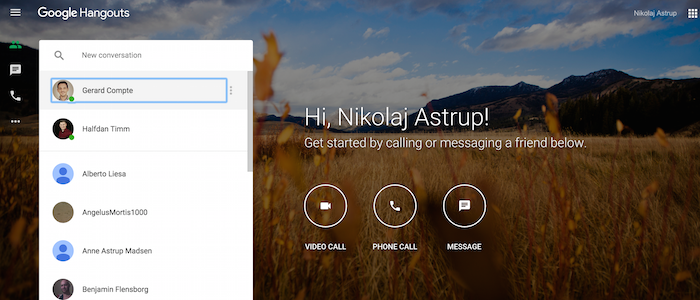
Using Hangout is a convenient way for communicating with your team and clients, especially if you are using other Google products. You can simply message your contacts from Gmail, or set up a video or voice call for a more personal communication. You can also share your screen or watch videos together.
| Price |
free |
| Main functions |
chat, video or voice call, screen share, watch videos together |
| Good for |
casual and quick communication |
| Website |
https://hangouts.google.com/ |
8. Webex

Webex is a group of tools made for meetings, events, webinars, training and remote support. It is a bit different from the others, as in you have separate tools for holding meetings with your remote team, for hold webinars and training courses, and for taking care of customer support remotely. Very versatile product group.
| Price |
the price depends on which product would you like to use, and how many people is involved. |
| Main functions |
meetings, webinars, trainings, remote support |
| Good for |
bigger teams |
| Website |
http://www.webex.com/ |
9. UberConference

UberConference is a tool for conference calls. You can share your screen, and you don’t need a PIN to join the conversation – you also see the who joined the call and who is talking. An interesting feature is the ability to check the attendees’ profiles on social networks.
| Price |
basic edition is free, Business edition is 10$/organizer/month |
| Main functions |
chat, screen share, video calls, searchable archives |
| Good for |
conference calls |
| Website |
https://www.uberconference.com/ |
10. Flowdock

Flowdock is a collaboration app, with chat and inbox functions. It keeps communication in one place, and it is searchable so you can find it all later. Available for mobile devices, so you can be updated on the go,and can be integrated with many other tools.
| Price |
free for teams under 5 members and students, for others it’s 3$/user/month |
| Main functions |
collaboration, chat, inbox, searchable |
| Good for |
keeping communication in one place |
| Website |
https://www.flowdock.com/ |
11. Sqwiggle

Sqwiggle aims to create a company culture for remote teams – it can be used for video calls, chat and an interesting feature is that you can see your co-workers’ faces. Sqwiggle takes snapshots through the day so you can see what mood your co-workers are in, what are they doing, and it also tells you if someone is not at their desk. By clicking on their picture, you can instantly start talking to them, and as usual, you can integrate this with other tools and share files on it.
| Price |
Basic edition is free, Plus edition is 9$/user/month, and Enterprise edition is 25+$/user/month |
| Main functions |
chat, video calls, snapshots of your team |
| Good for |
quick communication, bringing the team closer |
| Website |
https://www.sqwiggle.com/ |
12. 15Five

15Five is a tool for managing employee engagement. It is a simple idea: once a week, employees take 15 minutes to answer questions about how work is going, do they have problems, if yes what etc. The next step is answering and engaging in conversation about this topic. Sometimes it can be hard to manage a remote team, but with this tool you can easily discover where they need help, and what do you need to do to create a better environment.
| Price |
first 10 people 49$/month, additional users 5$/user/month |
| Main functions |
sends a few questions each week to your team |
| Good for |
bringing the team closer, measuring engagement and satisfaction |
| Website |
http://www.15five.com/ |
13. Sameroom

Sameroom is a bit different than the other communication tools in this section. Sameroom in itself is not a tool for communication, but it belongs here since it connects other tools together. It is for a situation where your team uses different tools for communication – for example, you use both Skype and Slack at your startup. In this scenario, Sameroom is handy, since it connects the two platform, and you don’t have to switch between the two.
| Price |
Trial version is free, Basic version is 9$/month, Pro version is 49$/month, and Sumo edition is 99$/month |
| Main functions |
connects other communication tools |
| Good for |
when your team uses different tools |
| Website |
https://sameroom.io/open-a-tube |
Tools for managing projects
How you manage your projects is a very important question, no matter if you are a remote team or not. The following tools were made to make it sure everyone has a clear picture of what is happening, what has to be done, who has to do it, and many of them also gives the opportunity to directly work together on documents.
14. Trello

Trello is a popular choice for team management. It is easy to use, and makes it easy to oversee projects – it is like sticking notes onto a board. You can have different boards, and within the boards you have lists. You can add cards to the lists, and you can add members, checklists, due dates, description, attachments and labels to cards. Within a card, members of the board can leave comments, so you will have all communication related to an idea or process in one place.
| Price |
Basic version is free, Business version is 8.33$/user/month, and Enterprise edition is 20.83$/user/month |
| Main functions |
boards, lists, cards, assigning members, comments, checklists, due dates, attachments and labels |
| Good for |
project management of all kinds |
| Website |
https://trello.com/ |
15. Asana

Asana helps you track projects from start to finish. You can keep track of projects, tasks, dashboards and conversations. It visualises progress, so it is easy to see how your projects are going. You can assign team members for different projects/tasks, and comment directly on the task/project . You can also add due dates and attachments.
| Price |
basic version is free, Asana Premium is 8.33$/user/month |
| Main functions |
assign members to dashboards, tasks, comment on them, visualise progress, also has option to add due dates and attachments |
| Good for |
project management of all kinds |
| Website |
https://asana.com |
16. Google Docs

Google Docs is great for sharing your files, and working on them at the same time. You can organize your documents and share whole folders, then you can either come and work together real-time, or leave comments on the file. It is a very simple and easy to use tool.
| Price |
free |
| Main functions |
share files, edit together in real time, chat and comment on documents |
| Good for |
editing and sharing files together |
| Website |
https://docs.google.com |
17. Quip

Quip allows you to create and communicate at the same place. Similarly to Google Docs, a team can edit the same document at the same time, and each document has a chat thread, so you can see all comments and feedback in one place. It is compatible with mobiles and tablets too!
| Price |
basic edition is free, the Team edition is 10$ for 10 people or 40$ for 20 people per month, the Business edition is 12$/user/month, and the Enterprise edition is 25$/user/month |
| Main functions |
edit together, has chat and comment function inside the document |
| Good for |
editing documents together |
| Website |
https://quip.com/ |
18. Basecamp

Basecamp is another tool for keeping track of projects, and who’s doing what in the team. It has six different functions. To-dos help you see tasks and who’s assigned to it, and the schedule gives you an overview of what’s happening. You can communicate in threads within the message board. For a quicker communication, use the campfire (the watercooler of Basecamp). You can use automatic check-ins (“What did you do today?”) to stay in touch with your team, and last but not least you can have all your files in the same place, organize them into folders, and even color-code them.
| Price |
the first Basecamp is free, and after that it is a fixed price per month, no matter how many users. The “Basecamp for us” is 29$/month, and is recommended for teams without clients. The “Basecamp with clients” is 79$/month, recommended for teams with clients. The “Basecamp big” is 3000$/year, recommended for enterprises. |
| Main functions |
to-dos, schedule, message board, the campfire, automatic check-in and file-sharing |
| Good for |
cooperation, project management and keeping the team close |
| Website |
https://basecamp.com/ |
19. PivotalTracker

PivotalTracker is a project management tool for software teams. It simplifies collaboration within software teams, and it is built to clearly communicate priorities to the entire team. By using this tool, your team will always be up to date on who does what, and how is the progress going. Every project is broken down into simple tasks called stories, which are organized based on their priority. The most important task is always on top – and if priority changes, you can just drag and drop it elsewhere.
| Price |
Pivotal Tracker offers Startup packages (free, 15 or 35$ per month) or Pro packages (75, 150 or 300$ per month). The price depends on how many collaborators, projects and storage place would you like to use. |
| Main functions |
prioritise, deliver, accept, collaborate, share |
| Good for |
cooperation and project management for software teams |
| Website |
https://www.pivotaltracker.com |
20. Jira

Jira is a software development tool for teams. As usual, you can plan projects and tasks, track how is it going, and deploy your software when it is ready. It is used by many organizations, such as Linkedin, eBay, and even NASA, and it’s a great tool for helping teams ship outstanding software. It is harder to use than Trello, but very effective.
| Price |
the price depends on how many users you have and the extra functions/other programmes you would like to have with Jira, and if you want them to host or not |
| Main functions |
plan, track and deploy projects and software |
| Good for |
cooperating and project management for software teams |
| Website |
https://www.atlassian.com/software/jira/ |
21. Confluence

Confluence is more of a team management tool than a project management one. You can use Confluence to collect and organize information, create new documents, discuss and give feedback on the work, assign people, and to create a knowledge base. It can integrate Jira, which is useful if your focus is on software development. You can also search between the files, notes, meetings and people you have here.
| Price |
depends on the number of users, additional functions/programmes, and if you want them to host or not |
| Main functions |
collect and organize information, create and discuss documents, assign people, create a knowledge base, search |
| Good for |
team management, especially for teams using Jira |
| Website |
https://www.atlassian.com/software/confluence |
22. Assembla

Assembla is a project management tool for web developers. You can keep track of teams, projects, tasks, code and files here. It is also great for collaborating with clients, tracking time spent on a project, and can produce reports so it is easy to see the results and process.
| Price |
personal version is 24$/month, Group version is 49$/month, and Pro is 99$/month |
| Main functions |
manage projects, tasks, code and files, collaborate with clients and each other, track time and produce reports |
| Good for |
web development teams |
| Website |
https://www.assembla.com/home |
23. Github

Github is a project management tool for web developers. Great tool for collaboration, code reviews, and code management – it is easy to communicate using this tool, so it is ideal for handling a remote team of web developers. You can integrate various other tools to it.
| Price |
they offer 5 personal and 5 organization plans, and the price depends on how many private repositories would you like to have |
| Main functions |
collaboration, code reviews and management |
| Good for |
web development teams |
| Website |
https://github.com/ |
24. Podio

Podio is a very flexible project management tool, specialized for easy sharing and collaboration between teams. You can share files, manage tasks, and there are different features and extensions so it is easy to customize it to your needs. It also integrates with many other tools.
| Price |
basic is 9$/user/month, Plus is 14$/user/month, Premium is 24$/user/month |
| Main functions |
easy sharing and collaboration, task management, a lots of features and extensions |
| Good for |
very flexible project management tool for teams |
| Website |
https://podio.com/ |
25. Sandglaz

Sandglaz is a simple to use project management tool, which is flexible so you can customize it easily. What separates this tool is that it is very quick – you can tag people and sort tasks with hashtags into categories. As usual, you can comment on tasks and share files, plus integrate many other tools.
| Price |
5$/user/month |
| Main functions |
share files, assign tasks, comment, easily customizeable |
| Good for |
quick and simple project management |
| Website |
https://www.sandglaz.com/ |
26. Taskworld

Taskworld is a project management tool, which allows you to organize every aspect of work, communicate and collaborate with your team and keep your knowledge in one place. You can also create channels and groups, chat, and give feedback easily on the work.
| Price |
11$/user/month/workspace (the workspace is your virtual office) |
| Main functions |
chat and collaboration, keeping your knowledge organized, option to make channels and groups |
| Good for |
project management of all kinds |
| Website |
https://taskworld.com |
27. Prodpad

Prodpad is a project management software, where you can capture ideas and make product development plants. Roadmapping is very easy, as is saving the important ideas and feedback from your team or users. It also help you manage your backlog, and it integrates with many other tools such as Trello or Jira.
| Price |
Plus is 59$/month, Premium is 299$/month, and Unlimited is 2499$/month |
| Main functions |
capture ideas, manage product development, roadmapping, saving ideas and feedback, backlog management |
| Good for |
managing product development and for product management |
| Website |
https://www.prodpad.com/ |
28. Duet

Duet is a project management app for freelancers and small businesses. This integrated project management and invoicing tool is simple to setup and easy to use, yet gives you full control over data, and provides an efficient way to keep clients updated constantly. As usual, you can save, assign and give feedback on tasks and have discussions, and it also tracks time so you can precisely see how much time you have spent on something.
| Price |
49$ – one time fee! |
| Main functions |
save, assign and give feedback on tasks, discussions, time tracking, and invoicing |
| Good for |
freelancers or small businesses |
| Website |
https://duetapp.com/ |
29. Cloud9

Cloud9 is a tool for code development. It contains a code editor and an Ubuntu workplace in the cloud. It supports 40 languages, and you can code together in real time with your team. For developing, you don’t need to set up and maintain a system, you just have to pick the configuration, and you can start right away!
| Price |
Basic is free, Micro is 9$/month, Small is 19$/month, Medium is 39$/month, and Large is 79$/month |
| Main functions |
code editor and development, Ubuntu workplace, code together in real time |
| Good for |
code development teams |
| Website |
https://c9.io/ |
30. Draft

Draft is a collaboration tool specifically for writing. It is quite simple: you share your document or presentation, and the people you invited can suggest changes to it. After this you can decide to keep or reject these changes, and you can also save drafts as you go along. You can compare these in a view which highlights changes. This is a useful tool if you and your team are working on something, where it is important to see the changes and previous versions. It also has a neat transcribing function, so you don’t have to switch between windows when you need to transcribe something.
| Price |
free |
| Main functions |
save drafts, track edits and changes, transcribing |
| Good for |
writing together |
| Website |
https://draftin.com |
31. Hackpad

Hackpad is for instant collaboration. You can use it to save your ideas, or invite your team or all of your Twitter followers to collaborate with you. Similarly to other collaboration platforms, you can break down projects into smaller tasks, and assign it to teammates. It is a very flexible platform, you can form it according to your needs. You can use it from anywhere, anytime – your stuff is in the cloud, but you can also access it offline.
| Price |
free for personal use, private workspaces are 2$/user |
| Main functions |
lots of collaboration functions, assign tasks to members, customizable |
| Good for |
easy collaboration |
| Website |
https://hackpad.com/ |
32. Glip

Glip is a tool for task management, sharing calendars and files, chatting online and organizing video conferences. Since it aims to have all communication in one place, you won’t have to spend so much time in your inbox – and as a bonus, everything is searchable, so it is really easy to find what you need. You can also integrate other project management tools into it, so that is even more time saved!
| Price |
Basic version is free, Basic is 5$/user/month, and Pro is 10$/user/month |
| Main functions |
task management, calendar and file sharing, chat, video conferences, search |
| Good for |
task management and communication |
| Website |
https://glip.com/ |
Tools for keeping up
We think it is also important to take a slight de-tour and mention a few tools that you can use for keeping up with people and events. These are not necessarily remote-work oriented, but you can benefit from using a good calendar to remind you of events and deadlines, or having a note-taking app ready, so you can always write down your ideas, no matter where you are.
33. Charlie

Charlie is a personal assistant app, that does research for you. If you have a meeting with someone, Charlie will look up that person for you, and will send you a document with all the necessary information and recent news about your meeting partner. This saves a lot of time for a busy entrepreneur.
| Price |
free |
| Main functions |
researches the person you are meeting with |
| Good for |
people who have a lot of meeting but not a lot of time to do research |
| Website |
https://charlieapp.com/ |
34. Google Calendar

Google Calendar is a simple, yet effective tool to keep track of your meetings, schedules and due dates. It is very simple to use, and sends you reminders of the events you registered in it. You can share your calendar with your colleagues or clients, so they can see what you are doing – this can be useful for example when you are scheduling meetings, or just to keep track of what your team is doing.
| Price |
free |
| Main functions |
save events, meetings and due dates, set up reminders, share with others |
| Good for |
everyone! |
| Website |
https://calendar.google.com |
35. Evernote

Evernote is a great tool for replacing sticky notes! It is online, so accessible no matter where you or your teammates are, you can clip interesting articles, notes and photos from around the web, and you can collaborate, communicate and share easily. An interesting function is that you can present your notes at any time, as it has the ability to automatically transform into a presentation.
| Price |
Basic version is free, Plus is 24,99$/year, and Premium is 49,99$/year |
| Main functions |
save ideas and interesting things you read on the internet, collaborate, communicate and share easily, plus converts to presentation |
| Good for |
quick sharing and saving ideas/interesting things |
| Website |
https://evernote.com/ |
36. OneNote

OneNote is a digital note-taking app, similar to Evernote. You can use it together with your team to share ideas and notes, clip interesting stuff from the internet, and to save fotos. It is accessible from all kinds of devices.
| Price |
free |
| Main functions |
same as Evernote |
| Good for |
capture ideas, thoughts, and to-dos |
| Website |
https://www.onenote.com/ |
37. Wunderlist

Wunderlist is a personal to-do list, which you can also share with others. It’s a simple tool for keeping track of what you have to do, and when it is time, it reminds you to do it. You can access it from a wide selection of devices, even from your smartwatch.
| Price |
free for personal use, Pro version is 4,99$/month, and the Business plan’s price depends on the size of your team |
| Main functions |
to-dos, due dates, notes, and in the Business version you can also assign, comment, and share files |
| Good for |
small teams or those who are working alone/on the go |
| Website |
https://www.wunderlist.com/ |
38. Time Trade

Time Trade lets others see when you are available, and they can set up meeting with you automatically, which then shows up in your Google Calendar due to automated syncing. This saves time for both parties, and particularly useful if you are travelling or just have a busy week, or keep irregular work hours.
| Price |
a basic/personal account is free, the Professional version is 49$/year, and the Workgroup edition is 99$/user/year |
| Main functions |
automatic meeting scheduling, syncs with your calendar |
| Good for |
remote teams and people with unusual business hours |
| Website |
http://www.timetrade.com/ |
Bonus round!
To finish this list, let’s talk about a few apps that are also very handy and useful to have for remote teams. These are miscellaneous apps, some are good for managing different time zones, some help you keep your passwords safe, and some take over routine tasks for you, so you have more time for quality work.
39. Toggl

Toggl is a tracking tool, that helps you track tasks in real-time. You can mark what you are tracking – a meeting, doing work for client #1, or having your coffee break. It is built for teams, easy to use, and boosts productivity – there are handy reports and pie charts where you can see how much your team was working on a task, or how much time did it take to finish a project.
| Price |
Basic account is free, Pro is 5$/user/month, and Business is 59$/user/month |
| Main functions |
tracks time, generates reports and pie charts |
| Good for |
remote teams and freelancers |
| Website |
https://www.toggl.com/ |
40. Buffer

When you are working remotely, you might get a few time zones away from your audience at times. This can be problematic if you are handling social media accounts, as timing is very important here. Buffer is a solution for this problem – you can schedule your posts with it on different social networks, so your posts will be out at the best time for your audience to see.
| Price |
2 plans for individuals (free and 10$/month), and 3 plans for teams and agencies (50, 100 and 250$/month |
| Main functions |
schedule posts on social media networks |
| Good for |
social media management on the go |
| Website |
https://buffer.com/ |
41. iDoneThis

iDoneThis is a tool for tracking your progress easily – each evening you get a reminder asking what you have done today, and the next day you get a report with the answers of all your teammates. It’s a simple tool for keeping up with what is happening with your team.
| Price |
Personal version is free, Gold is 5$/month (it only adds extra functions to the personal version) and for teams it is 5$/user/month |
| Main functions |
tracking progress |
| Good for |
freelances or remote teams |
| Website |
https://idonethis.com/ |
42. IFTTT – If This, Then That

IFTTT is a tool that allows you to automate routine processes with a help of “recipes”. There are two kinds of recipes, the DO recipe, and the IF recipe. IF recipes are automatic: IF you post a picture on Instagram, THEN it saves it to your dropbox. DO recipes are not automatic, but only a click away: for example, you can upload pictures to Facebook with one click, or turn up the heat.
| Price |
free |
| Main functions |
IF and DO recipes, automates functions |
| Good for |
saving time, eliminating routine tasks |
| Website |
https://ifttt.com/ |
43. Zapier

Zapier is another tool that connects your apps and automates functions: for example, it saves the documents you attach to your emails into Dropbox., or sends you an sms when you get an email. This is good for eliminating small time-consuming routine tasks.
| Price |
free to use, Basic version is 20$/month, Business is 50$/month, Business Plus is 75$/month, and Infrastructure is 125$/month |
| Main functions |
automated functions |
| Good for |
save time, eliminate routine tasks |
| Website |
https://zapier.com/ |
44. Dropbox

Dropbox is a well-known, simple file-sharing tool. All your documents, presentations, reports and other files are stored in one place that is easy to share with your team. You can access your files even without the internet, since it saves the files locally too. Files update automatically when you are online, so you always have the newest version available.
| Price |
Basic is free, Pro is 9.99€/month, and Business is 12€/user/month |
| Main functions |
share files, access it offline too |
| Good for |
sharing files |
| Website |
https://www.dropbox.com/ |
45. Boomerang

Boomerang is an addition for Gmail, which lets you schedule emails to be sent later – this is a very useful function if you are working with a team that is in a different timezone. It also lets you archive messages, and bringing them up again when you need it (so for example it pulls out the email with your plane ticket the day before your trip). There is a reminder function too, so you will never forget to follow up on important emails.
| Price |
For personal use, the Basic version is free, Personal is 4,99$/month, Pro is 14,99$/month, and Premium is 49,99$/month. For teams it depends on the number of people. |
| Main functions |
send emails later, achieve messages until you need it, get reminders |
| Good for |
email management |
| Website |
http://www.boomeranggmail.com/ |
46. Prezi

Prezi is a cloud-based tool for creating and storing presentations. Your presentations are available anywhere, anytime, and it syncs automatically if changes are made. It is a simple, yet effective tool for the workers on the go.
| Price |
free to use, but your presentations can only be public. The Enjoy version is 9€/month, the Pro is 18€/month, and the Teams version is 13.25€/month |
| Main functions |
create and store presentations |
| Good for |
presentations |
| Website |
https://prezi.com/ |
47. World Clock

World Clock is an app for Macs, and you can see the different times on a world map. This is very helpful if your team is all over the world. With this app it is easier to manage communication with a global team, and it also helps you schedule meetings.
48. Figure It Out

Similar to World Clock, this app shows you what time it is in different timezones. This is an add-on for Chrome, and every time you open a new tab, you will see what time is it in the locations you added.
| Price |
free |
| Main functions |
see what time is it in different time zones |
| Good for |
a global team |
| Website |
http://www.fioapp.co/ |
49. Obindo

Obindo is a tool which takes the important information out of your emails, and saves it to the appropriate place. For example, you set up a meeting with a client via email, and Obindo automatically adds this meeting to your calendar, or it downloads and saves all the attachments to one place.
| Price |
basic is free, Starter is 25$/month, Business is 75$/month |
| Main functions |
imports important data from your emails and saves it |
| Good for |
a team who emails a lot, and to eliminate small routine task |
| Website |
http://www.obindo.com/ |
50. Meldium

Meldium is a tool for managing passwords within teams. By using it, you can easily give access to your team for all apps you are using without actually sharing passwords. This is a great method, as it protects from phishing and makes it a lot easier to set up new employees. In case you and your team are using many apps, it also makes life easier, because it remembers all the passwords for you, and you only need to remember one!
| Price |
Basic is 29$/month, Premium is 79$/month, and Professional is 199$/month |
| Main functions |
manage passwords |
| Good for |
a team who uses many tools and services |
| Website |
https://www.meldium.com/ |
We hope you found this list useful, and could find a tool to make your work easier and more efficient! Let us know if you have any other tools, creative ways of use these tools or any thoughts on remote work in general. We would love to hear from you 🙂

22. October 2015 | Blog
When following politics it’s common to hear politicians talk about how important entrepreneurship is for the future. It’s very difficult to question the importance of a country’s entrepreneurial performance. It’s of huge importance for the innovation, job creations and to attract foreign investments.
But how do a country get more (and better) entrepreneurs? One way is to incorporate it in the formal education. In my opinion this should be the absolute first steps. Kids in primary school has to know about entrepreneurship as a possible way in life, just as the learn that it’s possible to become a teacher or a doctor.
I always wondered why there wasn’t more about entrepreneurship in primary school, so I decided to see which countries did best in this area… And it turns out my own country comes in #1. I hope something changed since I left primary school or else it’s pretty sad that Denmark is number one on this list
The data is collected by the amazing Global Entrepreneurship Monitor, a partnership between over 200 institutions. GEM has collected data about global entrepreneurship for 16 years and does over 200.000 interviews each year.
Without further ado, here is the top 10 list (their score is based from 1-5, 5 being the best):

The United States is places #26 overall (Fear of failure: 29.11%).
Why did I include fear of failure?
GEM also collects data on fear of failure, which is defined as “Percentage of 18-64 population (individuals involved in any stage of entrepreneurial activity excluded) who indicate that fear of failure would prevent them from setting up a business”. So why did I include that?
I think it’s super interesting to see, that even though Denmark is #1 in education, the country is way behind on fear of failure (16th worst performing country). We could have included any other parameter here (like tax and administration), it just goes to show that a country’s success with entrepreneurship is super complex and a combination of many things.
Being high on one parameter doesn’t make the country an overall entrepreneurial success, but it’s a good start and where the long term success begins from.
And the losers
In the bottom of the scale the list looks like this (worst first):
- Bukina Faso
- Uruguay
- Brazil
- Greece
- Kuwait
- Chile
- Japan
- El Salvador
- Puerto Rico
- Australia
Sources
Data is from the Global Enterepreneurship Monitor (http://www.gemconsortium.org/) and from their latest data set (as of October 2015). The score is based on interviews with a minimum of 36 experts in each country.
Pictures from different countries via Flickr (commercial use allowed) from the following users: romanboed, qin1109, nathanhayag, aidanmorgan, justinjensen, fran001, tausp, marfis75, franciscoantunes, dahlstroms

Recent Comments