
19. October 2015 | Blog
The last couple of years I have been fortunate to travel a lot. I have spent approximately 10 months each year outside of Denmark in 15 different countries. I have lived and stayed at places in the span of a few days up to 10 months. I have been to countries very different from Denmark and I have visited European metropolises reminiscing home. I have worked at offices in boring environments, at cafés, and in awesome co-working spaces.
All this I have done in an attempt of working at the same time – not just by myself but with my girlfriend Michelle. As a conclusion to my adventures, I would love to share my experience with all of you, and I can already conclude that I am not done with travelling and working. ☺
This article might seem long so I have divided it into sections – jump directly between them if you find some of it a bit too heavy or simply not interesting. Total estimated reading time for the article is around 10 minutes.
- Where I have lived (including periods of time, type of housing, benefits and downsides)
- 10 things I have learned from travelling this way
- How I want to travel in the future
- 5 recommendations if you want to combine working and travelling
- 10 pictures that reminds me of why it has been worth it
- Conclusion
How I lived the last couple of years
Place: Beijing, China

The first placed we ever lived outside of Denmark, and where our desire for living this way was born. In 2012, my girlfriend and I went to Beijing to spend a year because of her Master’s degree. We always dreamed of living abroad, and all of a sudden we had the opportunity. Beijing seemed to be the perfect fit to our exotic expectations.
Period of time: 10 months, 2012-2013
Type of housing: Permanent apartment which we found through a real estate agency. Entirely normal lease as we know it, where you pay a deposit and sign a normal contract. To a large extent furnished, but without sheets, microwave oven, a couple of lamps which we bought ourselves. We did not get back all of our deposit, but it is China after all☺. All things considered, the rent was really cheap, but in extra expenses we did end up paying quite a bit, so a residential solution as the one in Barcelona would have been more economic appropriate (Airbnb, see more below).
Office: Found a spot at a Danish company who were willing to give me a desk for free, but with 4 hours of total travel time each day during rush hour, it was not worth the trouble. Mainly, I worked from home. It was extremely difficult to find office communities in China.
Benefits:
- Big plus on the adventure account
- Something crazy happens every day in the streets of Beijing
- Your senses are severely sharpened
- It’s a challenge settling down in a place so different
- We learned a lot about not only China, but also ourselves
- Experiencing the everyday life in such a different culture is truly an eye-opener
- You eat stuff you don’t know what is ☺
Downsides:
- We had never been to Beijing before – we probably should have visited the city before deciding to live there
- The winter was really tough and depressive (extremely cold, windy and polluted) – 10 times the Danish winter but with pollution too
- Too few “western” places to flee to when you had enough of China (for this, Shanghai would have been a better option). This point is a bit embarrassing, but Beijing is just so intense, that sometimes I felt like this.
- Extremely difficult to find good offices / co-working spaces and to find friends / creating a social life – you may at times feel very isolated and lonely because of this.
Place: Barcelona, Spain

Post-Beijing, we were at home in Denmark for a year. We have an apartment on Frederiksberg in the centre of Copenhagen, but after throwing in the towel* with a start-up I tried to get going and my girlfriend finished her studies, we were ready to start a new adventure outside Denmark. We decided that this time it should be something exquisite, comfortable and easier than China. Our new home should be Barcelona which we had been visiting consistently for a couple of years in connection to Refuga*. In the aftermath of our travelling, we have come back to Barcelona again and again, and it has gradually become our second home.
Period of time: 5 months, 2014
Type of housing: We found a wonderful apartment on Airbnb in an area without too many tourists and after some negotiation, we managed to drive down the price. Fully furnished plug’n’play place with everything we needed in terms of kitchen utensils, towels and bedding – unlike in China.
Office: 3-4 days a week at Regus, rest of the working hours at café or from home.
Benefits
- Extremely comfortable and way easier than China – all the things we wanted
- Fantastic city which was amazing to live in and feel the everyday life of
- Lovely to experience the seasons change, and with somewhat milder weather than in Denmark
- Mountains right in our backyard where we used to jog 4-5 times a week
- Very relaxed. Even if we worked 8-10 hours a day, it was very relaxing. As an example of this, we used to go to a small coffee shop every morning with the rest of the regulars
Downsides
- Almost too comfortable. Barcelona – and Europe in general – is very easy, nice and comfortable to approach, but we lacked adventures.
Place: Morocco
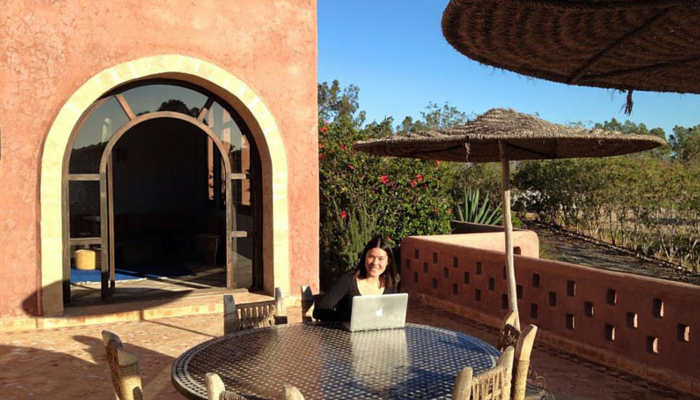
We kick-started 2015 by going to Morocco almost right after new years evening, because Refuga had a trip to Morocco in January. Our initial thought by this travel was to get our need for adventure satisfied, so we didn’t really plan on how long to stay there nor had we an idea of what was coming to us – we just wanted to let life do its thing to us.
Period of time: 1, 5 months
Type of housing: None. We were just travelling all around and we managed to overnight in both the Atlas Mountains, by the sea, at the house assigned from Refuga, and in incredible Marrakech. All in all, we were about five different places in 40 days (we decided to rent a car).
Office: None, wherever we were. During our journey, we did work 10 days at a co-working / co-living place in a small surfer / fishing village where we really worked our asses off.
Benefits:
- Nice to feel an adventure again, where something crazy would happen all the time
- Compressed travel where we in 40 days experienced a lot of different stuff in this amazing country.
- I fell in love with Morocco
- Overall an unforgettable experience
- Even if it was just one and a half month, we were so many places meeting so many people that I will always have a relationship to the country.
Downsides:
- Hard/almost impossible to establish a proper working routine when you get so many adventures under your skin in such a short amount of time.
Place: Santiago, Chile
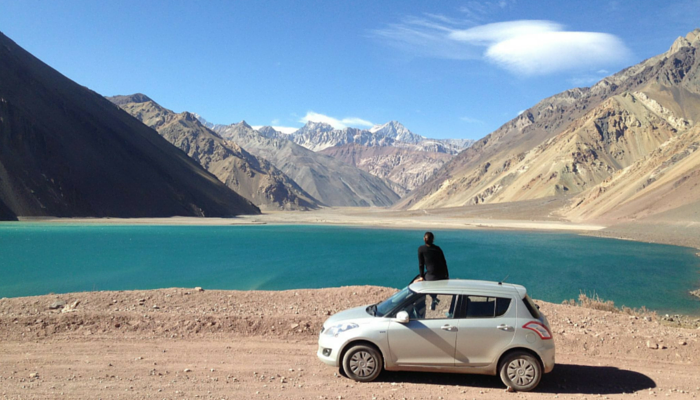
After Morocco, we went to Brazil, where my girlfriend has family, since it was a while since our last visit. As we earlier used to travel in Brazil, we knew it was a possibility to cross the border to one of the neighbour countries, so we wanted to visit at least one of the other countries nearby. Spontaneously, we ended up in Chile because it was easy to find a co-working space and because we knew that our place in Santiago would be next to a mountain side.
Period of time: 2 months
Type of housing: Apartment booked on Airbnb in advance. Super easy and straight forward, even though it would have been cooler to live at someone private and learn about Chile, since we didn’t get to see much of the country.
Office: Big co-working space filled with entrepreneurs.
Benefits:
- Two months of concentrated work served us well. We did line up the office and apartment in advance, so once again a very plug’n’play experience.
- Amazing nature right in our backyard
Downsides:
- The city was way too generic – Too much as we knew it from back home. When travelling so far from home, it has to be a bit more different.
- Way too much focus on work. We worked around 11 hours a day, so we did not have much time left for travelling around the country, and then it suddenly becomes a bad idea travelling so far away.
Extras
Beside the abovementioned, we have in periods of 1-21 days been to Italy, Austria, Poland, Slovakia, Portugal, Tanzania, Slovenia, Hungary, Croatia, Russia, and Singapore. It has been through Refuga, on weekend visits, places where we did stay and work for a week or two, and other forms of travelling.
10 things I have learned from travelling full-time
1. It’s definitely not as easy and exotic as many “digital nomads” are presenting it as
Many obstacles and frustrations can occur travelling and working at the same time. In theory, you are trying to combine things counterintuitive intentions. It is troublesome and expensive moving around all the time. You get into neighbourhoods and residences that are not as expected, and it takes a lot of energy to adjust. People often get the picture that living and working this way is very exotic, but that is not always true. Expecting everything to work out by itself will make you learn the hard way.
2. Clear priorities is a must
It took us a while settling our priorities. When we started this, we wanted to travel, be extremely committed to our projects, while I was doing sports on a high level. But it just is impossible to do so many things 100%, so you need to have your priorities straight. Through our experiences this year, we have learned that working should be our number one priority. It has been like that all the time, but we need to be better at having travelling as a definite second priority, and we do that by lowering our number of travels – more about that in the conclusion.
3. 2 times 80% is still more than 1 time 100%
Even with clear priorities, you are after all still trying to combine two things. My experience is that if you want to do something 100%, for example going all in on your company, you need to have an uncompromising attitude, and then it’s for no use to visit 10 different countries in a very short time span. That being said, you can get the best of both worlds. By lowering your ambitions just a tad, it is possible to both travel and work at the same time. 2 times 80% is after all more than 100%.
4. Everything is easier with good planning
We have been planning differently for our future at different occasions. It feels good to be spontaneous, but when you at the same time need to focus on your job, you have to plan it. By planning and scheduling well, you are making it easier for yourself. And by good planning, all I insinuate is that you do it early so you don’t get caught by surprises. For example, by travelling with Airbnb and just doing a small amount of internet research beforehand, it is super easy to move in a new place, but as it comes closer to travel time, the harder it gets to schedule.
5. Travelling equals education
The more I travel, the more fascinated I have become by this world. The more I travel, the more optimistic I become. I delude myself into believing that the more I travel, the more tolerant I become. To me, travelling is the wildest form of education. Fuck MBA, fuck online courses, fuck start-up accelerators. If you really want to learn stuff about yourself and our world, all you have to do is travel. If everyone travelled to foreign regions, we would all understand each other a lot better, and the world would have fewer issues to deal with. The most interesting, tolerant and open people I have met, are people who have lived outside their own country for a shorter or longer amount of time – I am a big advocate for having an obligated travel like this as an implemented part of high school, especially in the global world we live in today.
6. We are more alike than different
In Morocco, we met an American woman who was rather successful in the advertising industry in New York but was about to quit just to break free and travel. She said that one of the things she learned by travelling was that “we are more alike than different”, and I find that quote extremely well said. It connects to the idea that education equals travelling. The more we travel, the more we understand that people are alike despite different cultures.
7. Without a physical base, you will have to find base somewhere else
When you move around a lot, you have to be careful that you don’t become rootless. My limit for what I call home has started to change, and when I am in Denmark I don’t feel as much at home as I used to do. Denmark is the place I was born, but where do I actually belong now? That feeling of being rootless might lead to something good, I believe. When you don’t have a permanent physical base, you have to find another base mentally. Without having a 100% permanent physical base, I have been forced to find tranquillity and balance in myself, and during the many years of travelling I am starting to become more self-contained than ever.
8. I am extremely fortunate
Being Danes, we are extremely lucky. We are the richest and happiest country in the world. When you travel, you are easily reminded that many places are not as good as Denmark. Many people around the world have entirely different limitations, and when you experience that, you start to appreciate your own life. We are easily granted visa for every place on the earth, but other nations are not that lucky. To me it is a privilege to live this way and I cannot allow myself to miss out on an opportunity like this. My girlfriend and I remind ourselves how lucky we are each and every week.
9. The unusual makes you happy
I truly believe you become happier, when you travel and experience something new. Even when I have lived in Denmark, I have followed one simple rule of living* which is visiting at least four new countries every year. When I have been living in Denmark, things get the same very easily. You know everything so well, so your senses aren’t sharpened and you don’t notice the small things in life. Being in a new place, you notice languages, scents, the weather, and a lot of other stuff. I get that feeling visiting Barcelona which is very alike classic Danish environment – when it’s another country, it will always be a little foreign to you, and your senses are automatically sharpened. These things make me happier. I often feel happier, because I notice every small thing of the everyday life.
10. Go for the life that fits you
Just because Denmark is the place you are born, it does not necessarily mean it’s the place that will make you the happiest or the place that will grant you most opportunities. Living this way has been a pursuit on both a lifestyle and a place that fits us and makes us happy. As with many other things in life, you need certain experiences to learn stuff about yourself, and by living abroad in both shorter and longer periods of time, I really believe that I have gained some experiences which I can use for the lifestyle I want to practice. When I haven’t worked in front of my computer, my job has been travelling with Refuga.
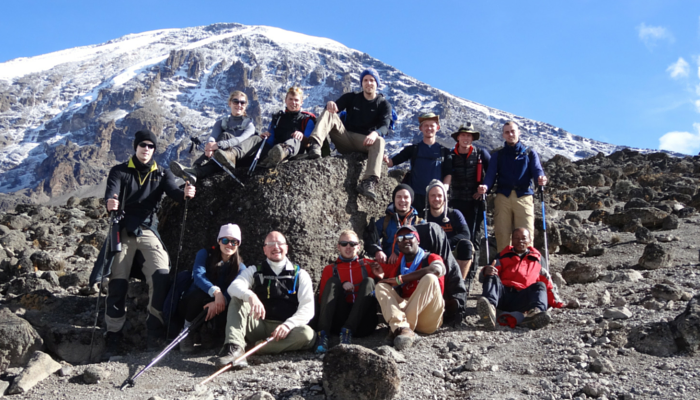
When I’m not travelling myself, I’m travelling with Refuga 🙂
5 recommendations if you want to combine working and travelling
Based on my experiences so far I have gathered a few recommendations if you want to combine your work-life with adventure.
1. Seize the opportunity properly
I feel like a lot of digital nomads like me tend to travel a lot to places where they will only meet people like themselves. Many will only pursue the great weather and cheap prices. It might be tempting with an easy, pleasurable experience, but if you only go for that, I think you will miss out on a great opportunity. You have the option to really learn stuff about yourself and the world we live in by going to places very different from Denmark. It is always nice with some beach and luxury life, but you can easily balance those two things. Even though I spend a lot of time in Barcelona, it is almost too easy. We have just now started our scheduling of 2016, and we have an insatiable hunger for adventure.
2. Travel as it fits you
There is no right or wrong way to travel. If you decide to live like this, you have a great opportunity to do whatever you want. So travel as it fits you, but make sure to get out of the comfort zone from time to time.
3. Make sure to have an economic buffer
When you travel like this, you don’t really know what might happen to you, so I highly recommend to have some economic backup just in case. If you lose some costumers, it might be harder to get new customers if you are abroad. If something goes wrong, you will always have economy for a couple of months, and it will make your life easier knowing that you have this buffer.
4. Make it as easy for yourself as possible
Unless you are 100% determined living the same place for a long time, I will recommend sites like Airbnb any day of the week to make sure you get what you want. It might be a little bit more expensive in the short run, but in the long run it might turn out the cheapest because of local arrangements and bureaucracy. That’s also why I travel on tourist visa (please notice that this might give you trouble in places like Thailand, because you need working visa to work in co-working spaces). That is also why I have found helpers via Elance, so they can help me plan or answer if I have any questions about the country which I do not speak the language of. This is something that really helped me.
5. Do it – at least for just a short amount of time
I cannot stress enough how much I can recommend this. I guarantee you won’t regret it, and you will learn more than in the same period at home. If you have the opportunity and the lust to do it, I highly recommend that you just go right now.
10 pictures that reminds me of why it has been worth it

Reaching the summit of Kilimanjaro with Refuga (photo by my friend Lars)
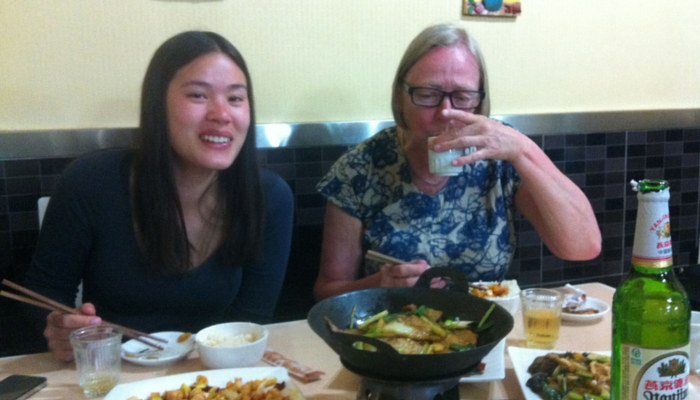
Having my mom visit us in Beijing was a great experience!
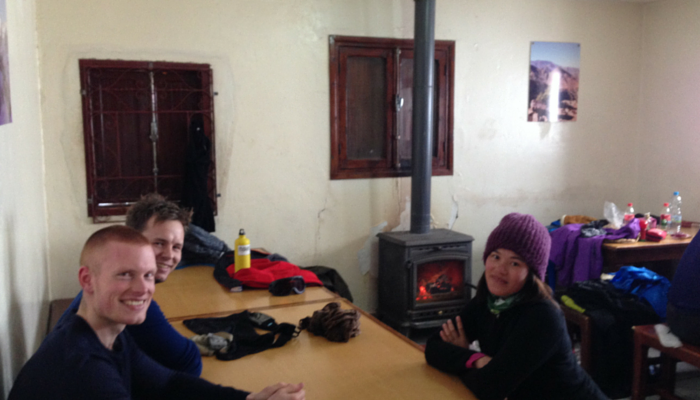
Enjoying the fireplace at a refugium in the Atlas Mountains in Morocco after being caught in a snowstorm – with good friends!

Experiencing the Brazilian carnival while visiting some family
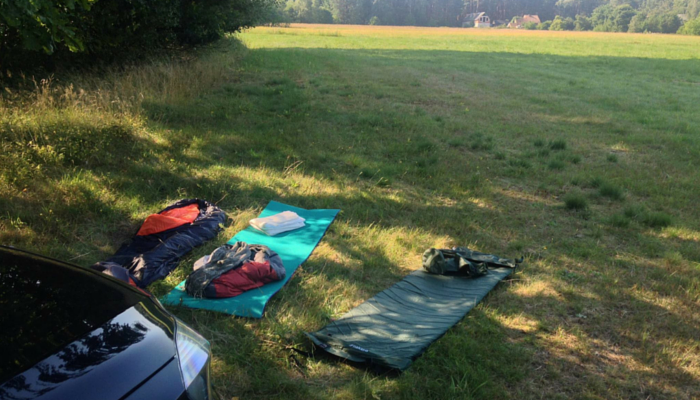
Sleeping on a polish field during a road trip through Eastern Europe
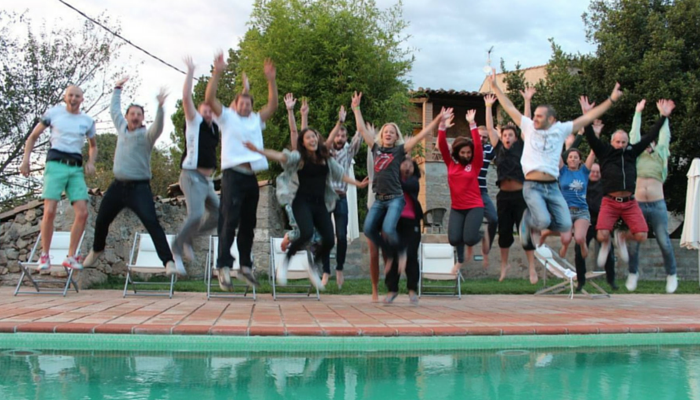
From the last day on our first international Refuga trip – A great experience that kickstarted me working on Refuga full-time.
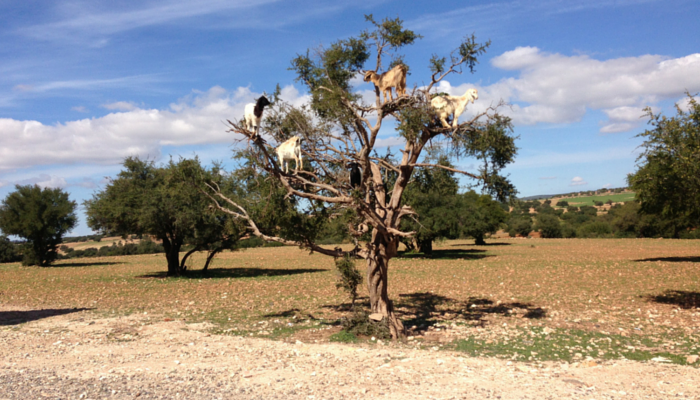
Goats in a tree in Morocco. This is exactly what I love about this country 🙂
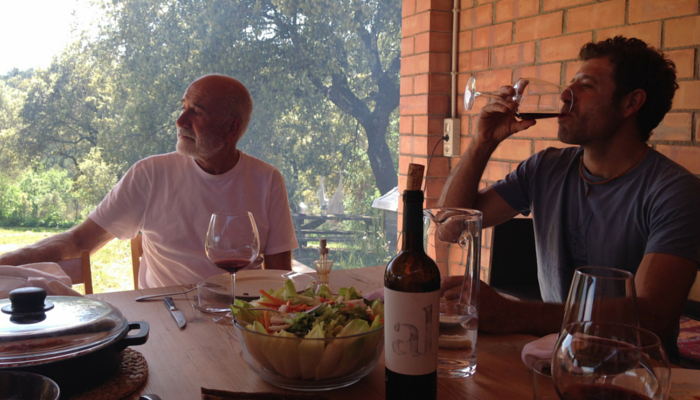
Eating a Sunday lunch with the family we work with for our Spain location.
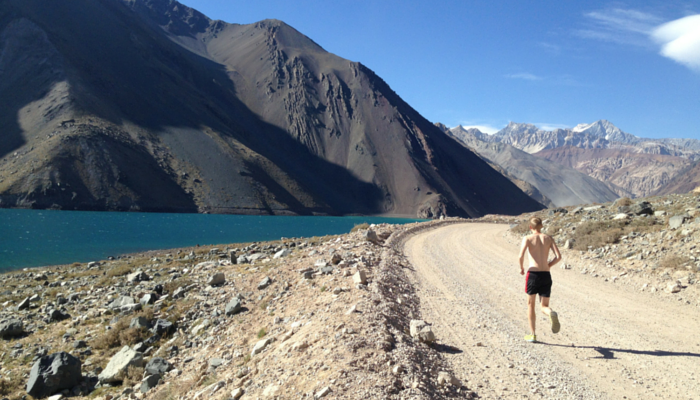
A break from the office in Santiago, Chile. That country has some incredible nature.
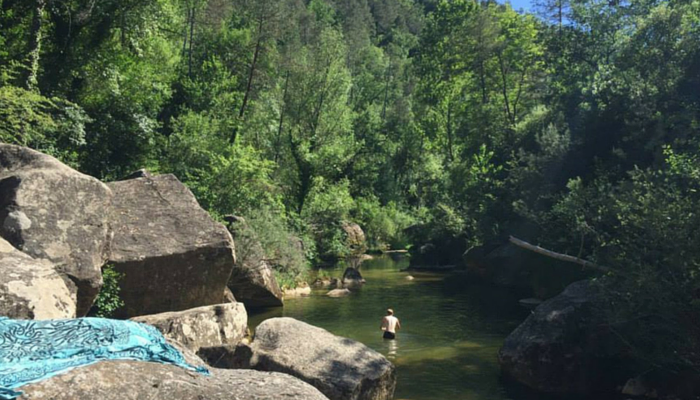
Swimming in a lake near our spanish location. Pure freedom.
Conclusion
If I have to draw a conclusion over the past two years of travelling and living outside Denmark, the overriding statement would be that it was totally worth it. It’s not a perfect lifestyle, but it is a way to learn about our world and ourselves. To me, it has been an educational journey where I have been gradually more certain on how to live in the future. I did not find the recipe to the perfect lifestyle, but I have become wiser, and I know what my next steps in life are.
Next year I still want to travel, but in a way so we spend 5-6 months each place. It’s the amount of time that has worked best for me. Without revealing where we are going exactly, I can tell you that we are going to places with the right combination of good working conditions and room for adventures.
In the long run, it’s difficult to tell where we will settle down. Denmark is still our home after all, and where our families live, so we might end up there, but nothing is safe to say.
One of the main conclusions is that long time travelling like this is a fantastic way to learn about yourself and the world around you. I wouldn’t swap my last couple of years for anything in the world.
Also, two other things came to my mind when writing this post: 1) I’m never sitting by a computer on the pictures that gives me the best memories. 2) A very big part of my best experiences has been with Refuga. Food for thought 🙂

15. October 2015 | Blog
In March I wrote this post on our blog “We’re hiring a Content Marketing Manager“. It was a time, where things were starting to take off slowly (at this point I had worked full-time on Refuga for approx 5-6 months). I thought it was a great time to invest in a bit more long term marketing strategy.
I’ve been a blogger (in danish) myself for years and that has opened a lot of doors for me. I like the idea of creating value through content and I find it super aligned with what we’re trying to do here at Refuga. At the same time we’re doing things super bootstrapped, so overall having content as one of our major marketing channels in the future is the way to go.
So I started out with creating the post, looking for one full-time person. The position was remote and since I’m remote working myself and always use freelancers around the world I know we could find someone super talented within a pretty small budget. The salary was set to $2.000 a month. We only got one “complaint” about that, from a guy from Scandinavia, who wrote that we were crazy for only offering such a low salary. What he didn’t think of was that the position was aimed at for example a person living in the Philippines or a person from the West that wanted to live a year in Thailand or at Bali.
127 applications later…
Even though maybe a few questioned the salary, we got 127 applications within a very short time. I also got a lot of emails about potential partnerships, opening local branches in different countries etc. So I just started out looking for one person, but ended up with way too many opportunities, so I was starting to become unsure about what I wanted to do.
At the same time there was a clear distinction in the applications. Some were clearly just looking for a job while others really wanted to get involved in the project. Some even offered to work part-time for free. At this time I must admit that I wasn’t completely sure what way to go, so this is the email most of the applicants got (note, Refuga was Called Workaway at the time)

When reading through all of the applications, I was super happy that a lot of people wanted to get involved and work with us and it kickstarted the idea of doing something different instead of just hiring one person. With that many people who wanted to get involved I thought it would be too bad to just hire one person. At the same time all of the opportunities I was receiving via email had me wanting to start out with a smaller investment in content. And yeah I know – $2.000 is not much, but it’s difficult for a small startup to do everything at the same time.
So the conclusion was:
- A lot of people want to get involved in Refuga
- We don’t just want to hire one
- We want to try to make these people more than just writers, we want them to really be a part of the project
- The financial investment should initially be small
This lead to me defining the concept of having a content team. The idea was simple: A member of the content team writes a post per month for us and each year they earn credits to go on of our trips.
The positive sides of doing things this way was:
- We only get to work with people who really like our product
- We get a bunch of writers instead of just one (different angles and type of posts)
- We get a bunch of ambassadors, who will spread their own articles growing our overall reach
- We get more people on the trips. Our experience is that when people have tried being on a trip they come back and share it, so the more people we can get on a trip, the better!
- The value for the writer is the $1.000 a trip cost, but our costs are of course lower than that
Creating a remote content team
The above email was sent out to 118 people and 24 people wanted to be a part of the team. Everyone was super positive and understanding and I think being open about it and just telling people about all the thoughts behind it was the right thing to do (I’m a big fan of complete transparency). Having more than 20% respond and wanting to be a part of the content team was great and better than expected.
I started out writing down a process for the content team (I have written down processes for everything we do more than once) and we started out. We quickly learned a lot and needed to adjust a lot. After a lot of testing and adjustments, we’re now 14 super talented writers. Some were just not good enough, others didn’t have time enough and in the beginning we were just not good enough at explaining the way this should work and what kind of quality we were aiming at.
After an initial phase where we started out from the bottom with no experiences creating a team like this I sat down to improve our process, so things would run more smoothly in the future. The process will of course be adjusted more in the future, but I think we have come a long way. You can find our complete process for the content team right here – it’s 14 pages long :-). Feel free to copy and use it yourself.

We use to Trello to manage the Content Team and in general I can really recommend it. I have a board for all processes in our company in Trello and we include all history when we update processes in there too.
To get an idea about how we manage the Content Team here is a screenshot from our Content Team Trello Board:

Now it’s time to scale the content team: We’re looking for 40 more writers
I must admit the beginning of the content team was difficult. The communication wasn’t perfect and the majority of the articles we got wasn’t good enough. I knew it would take some time to get those first learnings, but it took more time and energy than expected.
It’s been a long, slow process but now we have a the first experiences, we have a defined process that we know works (it can be better and will of course be optimized as we go, but for now it’s good) and we also got some numbers that shows us that creating content can be a really good source of traffic.
Right now we only have 23 blog posts live, but we get almost 1.000 visitors per month who enters the site via the blog. A bit more than half comes from organic search, the rest from social. I know these are incredible small numbers, but that is exactly why we want to scale it.
So we know it can be a good source of traffic for us, we have a tested and proven process now and we know a lot want to get involved in Refuga on this basis. So it’s definitely time to scale this thing. We’re looking for 40 more writers. You can read more and apply right here.
Will the content team be good business for Refuga?
We know that it can be a really good and cheap source of traffic for us, but finding a post like this, this or this on Google and to buying a trip there is quite a long way. For now our only focus is just to make something cool, build the community and focus on creating value through content.
Right now people are staying on the blog for quite some time (+3 minutes), but we have a bad bounce rate (+80% – auch) – These are the numbers from the last 30 days:

So we know the content works, people are actually reading it (we also see a nice levels of shares and comments). Right now we don’t do anything to get people more involved on the blog. There are no related articles, there is no widget / boxes with upcoming trips, so this is definitely something we will focus more on in the future, but you need to start somewhere, so right now we will focus on creating good content and growing the team and then the next step will be to get more out of this traffic.
Our challenges and focus with the content team (short term)
So we have decided to focus more on the content team and to really scale it, but overall there is still a bunch of challenges and things we need to focus on. Here are some of the things we will focus on in the near future:
- Growing the team to 50 writers, adding 1-2 AWESOME posts each day
- Improve our process even more. It really need to be working smoothly when having 5 times as many writers
- Being better at defining our themes. Right now our content is very broad, but with more data and experience we have to focus a bit more (to create better and more relevant content)
- In my opinion we have had a bit too many writers who started, but dropped out again. I think we can do more to create a community around the writers and to engage them more in what we’re doing. In the future I will use the content team to also get feedback on some strategic things (to involve them more and to get feedback from a super talented bunch of people).
Got any questions about the content team or how we do stuff? Feel free to ask in comments! I’m already looking forward to doing the post after we have had 50 writers for some time 🙂

3. October 2015 | Blog
Today’s modern society is all about materialistic consumption. We are made to believe that more is good and success is having the most and fast. Chasing materialistic happiness is elusive as the satisfaction from possessing a tangible thing is short lived. The more we hoard, the more complicated our lives get. Minimalism is about leading a uncomplicated and decluttered life.
To begin with minimalism is not a fad, it is way of living. A life where less is more, being happy and content with less. Minimalism does not mean self denial, it just means being a conscious consumer. If we do not have a lot to take care of, to tidy up, it leaves us with time on hand that can be utilised for contemplation, reading, writing or any other fulfilling hobby.
Having grown up in India in a family where Mahatma Gandhi was considered an idol, I have never had an extravagant lifestyle. But it was not a conscious choice to lead a minimalist life. Some years ago I came across the Marie Kondo way of tidying up. That struck a chord within me, I questioned myself if I really needed all the stuff I planed to buy. Most of the times, I did not. Which then made me introspect a lot about the importance of intangible things around us that bring pleasure.
I, then, came across a fiscal fast challenge. I was not sure I would be able to suppress the intermittent guilty retail therapy trips but lo and behold I did! Not only was this about spending less money, but also evaluating my life choices, getting out and about in the nature more often to practise mindfulness and really valuing relationships. This lead me to believe that minimalism is not about less, it is about making room for things and people that make you happy.
I started actively looking for resources to help me practise this new way of life and found a lot of inspiring material on the net.
It can be easier said than done to practise a simple life with a lot of distraction around us. However, once you have had your awakening, there is no stopping you. One does not have to turn a minimalist overnight, it is a transition and takes time. Once you have made a conscious decision, after having realised the effects of a happy life, one thing will lead to another and you will find your calling. Meanwhile, to keep you focussed, you can try to inculcate the following:
- Find your tribe – Once you have chosen your path, you need to follow the trail. It is more than likely to find like minded people on the trail who will help you stick to your goal. The blogs about minimalism and zen habits never fail to inspire. Being surrounded by people who have similar beliefs helps immensely. Spend time with people who really value you as a person rather than your possessions.
- Do not follow the herd – People who lack self belief, look for external factors to feel good about themselves and get bogged down by peer pressure. This ofcourse leads to dejection. Happiness is a state of mind that a promotion at work, the next best car or a bigger house cannot contribute to. Chasing wealth is an endless race which often is disappointing. Standing apart from the crowd is an empowering feeling that boosts your self confidence.
- Finding a passion in life – This could be your childhood hobby of sketching Mandalas or writing, anything that ignites a spark in you. In my case, I discovered the art of painting stones. I can spend hours painting and not miss a thing going around in the world around me. That, to me is meditation. The contentment is inexplicable. Some people take to travelling, getting to know new cultures and meeting new people is an exciting experience. There is a saying – own less, travel more!
- Enjoy nature to its fullest – This lead me to read up on friluftsliv. It is a Norwegian word describing a way of life, where being out in the nature is described as good for human mind and body. It does not have anything to do with expensive equipment, just a walk in the forest goes a long way in freeing up the mind. Hiking, trekking, skiing are all good ways to connect with nature.
- Do not let acceptance and recognition direct your actions – Everyone else is fighting their battle to come to surface as the best. Do not get into the survival of the fittest race. Slow down and be happy with little progresses in your life, like a healthier life or quit smoking. The below quote says it all.
“Watch any plant or animal and let it teach you acceptance of what is, surrender to the Now.
Let it teach you Being.
Let it teach you integrity — which means to be one, to be yourself, to be real.
Let it teach you how to live and how to die, and how not to make living and dying into a problem.”
– Eckhart Tolle
If you are reading this, chances are you are considering treading on the path to a minimalist life. It does not require a lot of effort to turn into a minimalist, it is a matter of choice. We live in a society where most succumb to the allure of wealth and razzmatazz, that has lead to an increase in the number of people suffering from depression and anxiety, apart from physical health deterioration due to unhealthy eating habits. The chosen few, who prefer to lead a unpretentious life, do not experience bouts of disillusionment.
Start with baby steps. It could mean
- Being conscious about piling books. Check if the books you plan to buy are available at the local library or better rent ebooks from libraries.
- The amount of money spent on eating out and casual cups of latte, when added up is not always a meagre amount. Bring world cuisine to your kitchen!
- Plan unplanned weekends. Too many activities during the weekend does not allow the mind to rest properly before bouncing back to work on a Monday.
- Invest time in walking or running. Not only does it have physical health benefits but also cognitive benefits.
To each their own. There are myriad ways to lead a frugal and happy life, you will have to choose the path that best suits your life. The most important part is to start living, not just existing.
“It is not uncommon for people to spend their whole life waiting to start living”
– Eckhart Tolle

17. September 2015 | Blog
Fair warning: this is not an article about the on-demand economy and the independent contractor as a means of labor. This is about the dramatic shift of how start-ups are currently being built. The story of the lone entrepreneur driven by a prophetic vision of the future, mindful of every step of masterful execution, while slowly converting each and every doubter into joining his/her mission of world domination is, to put it frankly, over. (It does, still, make a killer plot line for a superhero flick.) I am not saying this dream no longer exists, I am saying that plot line may look a bit different.
Remote Collaboration: Matching Talent With Opportunity
Today’s entrepreneur lives in a much smaller, more connected world than his/her predecessors. With the increase in platforms that have revolutionized remote collaboration (like Slack and Trello), working with someone five time zones away is instant and seamless. Gone are the days when offshore working was equivalent to baby-sitting a toddler on a sugar high: frustratingly impossible. The chance for miscommunication was larger than anyone focused on quality preferred and accountability became as petty as faulting the exact diction of an email. It wasn’t worth the time or money. So one could see the opportunity that it presented to start-ups, where those two resources are used most sparingly.
Today, remote work is nearly ideal for start-ups. The ability to work with specialized talent without having the added stress of relocation and financial stability is a big deal. Imagine that you are a talent interested in joining a start-up mission, but in order to “feel it out” you have to completely commit to moving across the world. You may want the company to be more financially stable before you make a global transition. As a start-up, that talent may be pivotal for you to push the company towards stability. It’s a chicken and egg scenario. Remote working allows for both parties to meet halfway. Just like time and money, energy is a pivotal resource for start-up success. The ability to tap into fresh energy without taking large risks has reduced startups’ chances for failure.
It became quite clear that a company seriously looking to adopt remote working habits needed to make the proper investment of communication infrastructure and technology to be successful. Thanks to pioneering companies such as WordPress and 37 signals, have begun to embrace remote working cultures. Matt Mullenweg is often seen as the father of remote working. He faced constant doubt when WordPress was growing at a rapid pace. Many people thought it could not support x amount of people. When it reached 50 users, they said it would surely break after reaching 100. As this argument became more and more redundant and the number predicting when it would be unable to scale became bigger and bigger, people harped on the details instead. They argued that remote work was “industry specific”, mistakenly labeling programming as an isolated craft, where collaboration was not present or necessary. That is far from the truth. It is a myth, created to support a weak argument. It is undeniable that remote work is becoming exponentially popular in many industries and continues to assert its place in the world economy. Mullenweg says it perfectly: “ We aren’t anti-office, we are location agnostic.”
Lean and Mean: Increasing The # of Start-ups
“Uber, the world’s largest taxi company, owns no vehicles. Facebook, the world’s most popular media owner, creates no content. Alibaba, the most valuable retailer, has no inventory. And Airbnb, the world’s largest accommodation provider, owns no real estate. Something interesting is happening.”
— Tom Goodwin
Any time in history where building has become cheaper and faster, there has been a great boost in the supporting ecosystem. In the 1920’s, Henry Ford’s assembly line created a huge demand for the Model T, opening up the road for Americans. Traveling was no longer a luxury, but a lifestyle. The ecosystem responded with the creation of the open road and entrepreneurs took advantage by creating businesses to accommodate the traveler.
Creating a start-up used to be the wild west. Now with cloud-based server space and just about an API for everything, it’s the new assembly line. Conditions are ripe for start-ups. Thanks to the lean entrepreneurship movement, boot-strapping has become the rule rather than a fad. The benefits of contracting a worker versus full employment favors the entrepreneur’s wallet. (As I write this, California’s courts reached a decision to treat Uber and Lyft drivers as employees rather than as independent contractors, a decision that will have far-reaching implications for the entire business model for the shared space economy.) Freelancing has become so popular that VC’s have dubbed it the “1099 economy” marking its recent impact on the landscape. It goes back to the basic entrepreneurial principle of optimizing input while minimizing risk. In this case, entrepreneurs are optimizing talent, while minimizing the risk of full employment (which includes benefits and additional perks).
The strongest variable of all is the way society has responded to the lean movement by managing their expectations. “Beta” has become a part of everyday conversation while “iterate” is the new launch. This embrace by society has changed the way products are released and developed: quicker to market, faster to traction, and turnover rates between builds are the new ad heavy, elaborate, high budget launches. Even the biggest companies have resorted to the strategy of asking entrepreneurs directly: “What do we build?” As open source is the new proprietary IP, start-up acquisitions are the new pillars of expansion, and multiple integrations are the only means to survival.
All of the this has created the “perfect storm,” enabling startups to fail faster and cheaper. This may seem counterintuitive, but as Dan Senor and Saul Singer stated very effectively in their book Start-up Nation: The Story of Israel’s Economic Miracle:
A 2006 Harvard University study shows that entrepreneurs who have failed in their previous enterprise have an almost one-in-five chance of success in their next start-up, which is a higher success rate than that for first time entrepreneurs and not far below that of entrepreneurs who have had a prior success… Israeli culture and regulations reflect a unique attitude to failure, on that it has managed to repeatedly bring failed entrepreneurs back into the system to constructively use their experience to try again, rather than leave them permanently stigmatized and marginalized
In other words, more failures equals more success. We will witness more failures today than ever before, which will in turn create the highest chance in history to succeed.
The New Work Force: Breaking Up With the System
Millennials are the newest face of the workforce and must therefore accept responsibility, just like the current administration is “responsible” for the most recent state of the country. From a nearsighted perspective, it seems like they are reluctant to pay their dues and immediately want to work on things they are passionate about. Can you blame them? It’s like being in a relationship with no trust or love. If you have one, you have a fighting chance, without love or trust, it’s pretty hopeless. The previous generation may have proven their grit by barreling through passionless work, but at least trusted that they had a job. Millennials have neither and they are not settling for that.
Since Britain’s industrial revolution, the model of the traditional work force has seen very little innovation. The 9-5 work schedule was set in the 18th century to optimize factory production and time for recreation. But as the whole world rapidly changes to create a more custom experience, why is work limited to such a finite structure? The question has been asked many times, but now people demand an answer. Pointing fingers to “laziness” rather than acknowledging the changing times is no longer sufficient. The new work force is building a new system to house their new set of values. They prefer improving a skill set over a job title, time and excitement over money and redundancy, and autonomy over hierarchy.
This has created a new lifestyle movement for independent contractors. No longer are they bound by the restraints of their employers. You want unlimited vacation? Become a digital nomad, living and working from an Asian coast. Do you prefer waking up at 8 a.m. and hustling to catch a bus before settling down for an hour commute? Or would you rather set timeframes where you are the most effective, creating a task-based mindset rather than obsessing over a ticking clock? Not only are flexible options more beneficial for workers, it creates a higher quality of work and trims fat from internal bureaucracies.
Many companies are not willing to consider giving up that initial control that is the proper foundation for this lucrative, mutually beneficial style. Some can’t let go of having complete control over their employees. I can assure these folks that as this terrain becomes more and more developed and more companies and workers adapt to reflect the change, they will have a very small talent pool to choose from, making them unable to sustain their growth and leading to their eventual demise.
The Future, Said Everyone
There are a thousand predictions one can make about the future, including extractions from Sci-Fi movies or references to how history is destined to repeat itself. I, myself, think change happens in minuscule degrees, over time, like a child’s slow growth. One day you look at your 10 year-old daughter and wonder how your little baby has suddenly turned into a preteen. The trick is not to wait until history reveals the verdict. By then, it’s too late and you have missed the boat.
Simply take a look around – a real look. We are living in a society where the future generation is being taught to constantly question social constructs. Twitter accounts are infamously revealing more facts than our own trusted media publications, and group messages are becoming more of a symposium than our very own classrooms. Truth can no longer be hidden behind physical boundaries or be the products of manufactured intentions.
How long will it be before an outright rebellion against an outdated working structure breaks out? More importantly, what will it take for companies to begin investing in this inevitable future? Has it already started?

Recent Comments