6. April 2015 | Blog
I love transparency and I love that more and more startups are being extremely transparent. I think it’s a great development, that will hopefully grow.
But it’s easy to just think this is a cool movement or development. You have to try it, to experience the pros and cons personally. I’ve tried to be very open the last couple of years. I did that via my personal blog and social media (all in danish, so won’t add links). My experience is that there are both pros and cons when it comes to being very open and it’s difficult to say if it’s worth if.
Last year I shared the complete story of a company that I was a part of, where we stopped the project. A failure and defeat. I experienced that my existing network (not those close to me) thought a bit less about me. I got the feeling that I was not that big a part of the established community any more. But I also got contacted by a lot of super cool people, who appreciated that I shared my story. So there were pros and cons. But the best thing about, was the feeling of being completely open and not having anything to hide. That feeling was in the end the reason, why I thought it had been worth it.
So, I’m still a big fan of being transparent and I want to bring that to Refuga, so here is a report of some of the numbers behind Refuga in Q1 and my focus for this month (April). I don’t know if this will be something I will do on a regular basis. I’m just sharing now, because I feel like it.
There is a few things I would like to mention, before jumping to the numbers: Please have in mind, that Refuga is an extremely small project so far. I’ve only considered this as a real startup for a little less than 5 months. The same period that I’ve worked more or less full-time. Also have in mind, that I’m still tweaking and adjusting the concept, so I’m not focusing on scaling big yet. The numbers you will find are small – I know that – but given the history, time spent and the phase that the project is in, I’m pretty happy about them.
Q1 2015 report: Check out revenue, traffic, social media and more numbers of @refugacamp CLICK TO TWEET
Q1 report: Let’s look at the numbers
Newsletter
Last year I didn’t work with newsletter at all. I had quite an OK list, from a competition I did once and I know how much it’s worth, so this has been a big focus. I wanted to test a lot of things, so get as many visitors converted to the newsletter. It’s my focus to get new visitors to convert to the newsletter, because it’s easier to sell a trip via that, than a first time visit to the website.
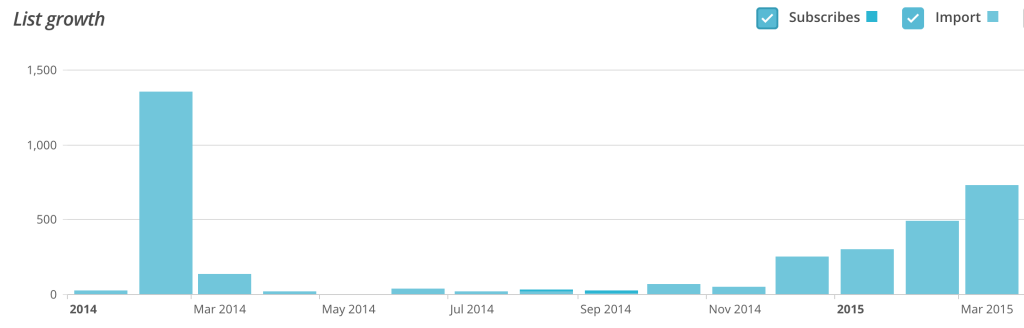
This is the graph from Mailchimp. The numbers from Feb 2014 is from the competition I did, when I wanted to do the first international trip. What you can see from December 2014 to March 2015, is the improvements made to the site, to get people to sign up.
Total signups in Q1: 1.515
Total signups: 3.502
Opening rate: 30%
Conversion (from website visitor to email signup) Q1: 9,3%.
The numbers are getting better and better and we have an average of 25 signups per day now. My first goal is to get that to 75, which I think is very realistic. I’m really happy about the conversion rate and I think it’s time to focus on getting more traffic (hasn’t been a focus at all really).
The opening rate is also becoming better and better. This has been pretty crap, since the competition last year gave a lot of signups with low quality. I think I will soon clean the list and remove everyone who hasn’t opened the newsletter the last year or something like that.
I’m gonna do another post about the newsletter, with insights about what works and what doesn’t, which pages they come from, which traffic sources is best for Refuga etc., so I won’t go into more detail here.
Social media
Social media is extremely valuable for Refuga. It gives a lot of traffic, signups and people buying trips. Refuga marketing is all about social media and the strategy behind is something like: “hack it as much as possible to get new, relevant followers and then do a great community management job”. I will also do a post about this at some point, so here are just some overall numbers:
Facebook
Facebook likes total: 5.208
Couldn’t find an exact number for Q1 in the insight section on Facebook. Let me know in the comments, if you know how to find this.
We use Facebook a lot, because the combination of text, pictures and video give a chance to really build a community. My hope is to get followers from other platforms to also follow us on Facebook, because we communicate the most there. It’s just difficult to be really engaging on a lot of platforms.
Twitter
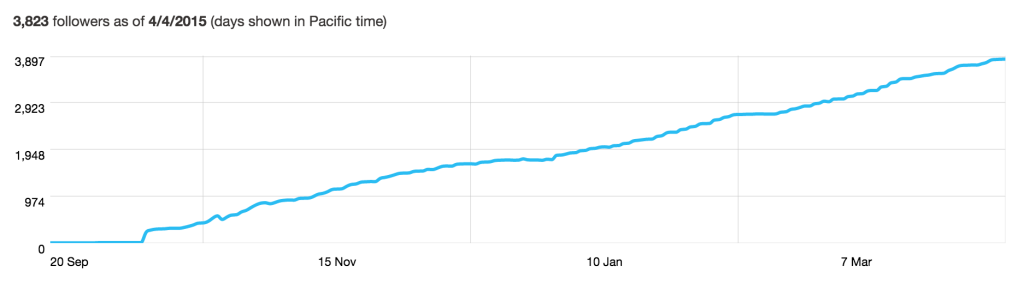
Twitter followers Q1: Approx. 1.990
Twitter followers total: 3.826
Twitter is awesome, because it’s so easy for people to share. Most of the bloggers and journalists who have written about Refuga, found us via Twitter. Also, it gives around 75 signups to the newsletter per month.
Instagram
Instagram followers: Approx. 11.800
I don’t have the number for Q1 followers, but it’s around 8-900 new per month or something like that. I like Instagram, because Refuga is a visual “product” and Instagram is perfect for that. We also get around 80 email signups per month from Instagram and two of our first international participants found Refuga via Instagram. I think that’s pretty cool.
I’ve also experimented a bit with Google+, which I personally like. I haven’t done a lot yet, but we almost got 3.000 followers. My experience is that the quality of the followers is lower than the other social platforms and I don’t know yet, how great it will be – BUT, it’s very, very easy to hack.
Website visitors
The traffic on the website is growing pretty well. I’m pretty happy with the numbers, because there are only 67 pages indexed by Google (= there is not much content yet) and I almost don’t spend money on marketing (only a bit on Facebook ads, mostly retargeting). Here are the numbers:
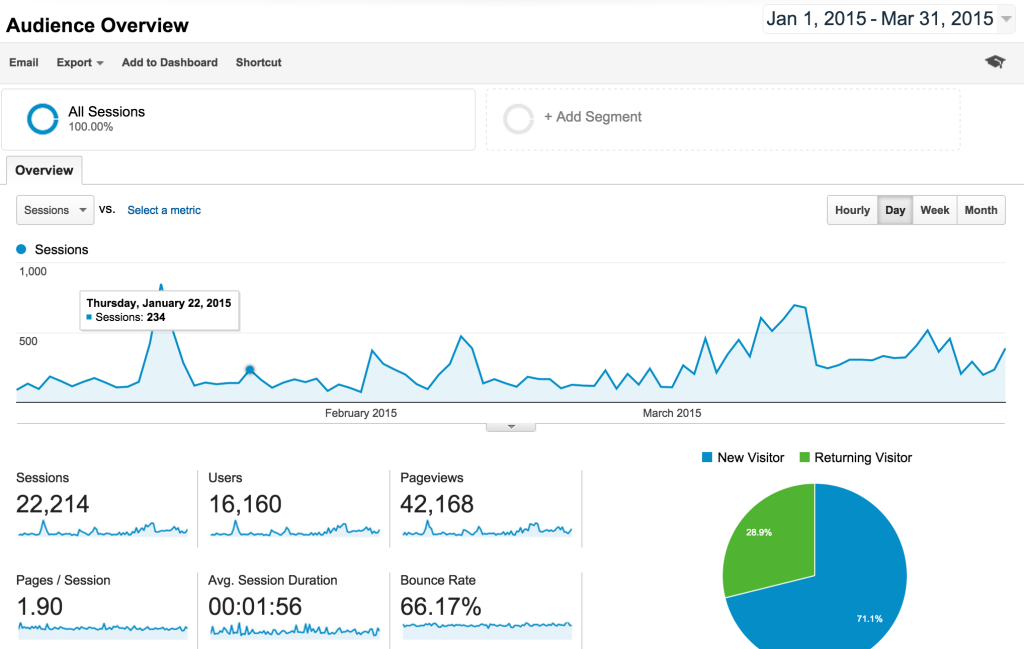
As mentioned, I’m pretty happy about these numbers (note that this is from all months in Q1). Getting traffic hasn’t been a focus at all, so this is something I will soon get really focused on (working more with content etc.). These number with a very little effort, gives me comfort that there is a great potential in growing the numbers.
The bounce rate and avg. time per session are not great numbers. There is a lot I can do to improve these numbers. I try to develop each trip landing page as a small world on it’s own and not just another product page, so that’s a part of the reason. I can absolutely do a better job in getting people from the front page to trip pages. This will be the first thing. Other focuses will be getting people from the blog to trip pages and people visiting a trip page, to visit more trip pages.
I can’t wait to really focus on this. There is so much that can be done!
Q1 2015 report: Check out revenue, traffic, social media and more numbers of @refugacom. CLICK TO TWEET
Applications
All trips is on an application basis, meaning that you have to apply to get a spot. We like diversity and we’re extremely open, but of course you have to have something to offer the rest of the group to join. This is not done to be snobby, but to get participants who really want to join and to ensure the best experience for everybody. It’s really a difficult balance and I’ve had different ideas about removing or making it more difficult to join, but I actually like how it’ works now.
Total applications in Q1: 79
Sold spots in Q1: 53
Refused in Q1: 6
So there have been 20 people who applied but didn’t end up as a confirmed participant (by paying). This is something I will work a bit on to improve, because there is some obvious potential (to get more participants and to waste less time). The first thing I will do, is to offer to book a 15 min clarifying Skype meeting to everybody who applies. I think what is holding people back, could easily be addressed in a short call, so I will experiment with this. The first meeting has already been booked 🙂
Maybe at some point, the whole application and payment flow should be redesigned. One idea could be people to confirm their application by typing in their credit card information. The deposit shouldn’t be drawn from the card before the application is approved, but this is something that could remove those unserious applications, that will never end up paying anyway.
Paying is not a positive thing, so I think it’s important that people do this when they are most engaged and I think they’re more likely to pay when they apply, but it’s just a theory. The negative thing could be missing those, who want to join and applies, but who has some questions and are not 100% ready to secure the spot yet. It’s something I will test.
Only 0,37% of the site visitors apply for a trip. Comparing to e-commerce this is extremely low, but I’m unsure what to think about it. I won’t expect this to sky rocket, because it is a big decision to join a trip and not just like buying a t-shirt online, but I’m sure this can be a bit better.
Should we talk about money too?
Of course we should.
In Q1 the total revenue has been a $48.370. The number is not 100% precise, because my company is danish and therefore my accounting system is in danish kroner (some of the the trips are sold in DKK, because they’re all danish), so I just used todays exchange rate.
My goal for the year is around $215.000 (or 1,5 mill DKK). There are more trips in the fall than in the beginning of the year, so I’m pretty sure I will hit that.
As mentioned in the very beginning of this post, I know the numbers are low. But let me remind you, that Refuga hasn’t found exactly the right business model yet. I’m getting closer, but it’s not 100% there and I’m not completely ready to scale.
I won’t go into talking about profits. I can survive and travel the world with my girlfriend. At the same time there is enough cash and the cash flow is pretty good, so I’m able to invest in testing, improving and growing organically.
Overall, I’m pretty happy about where I am after just under 6 months full-time and I’m very excited about the future. The to do list is long 🙂
Focus for April
The last months I’ve tried to launch an alpha version of making Refuga “open source”, meaning that other people should be able to do Refuga trips. I’ve recieved over 30 applications for being a Refuga Organizer (via this page). The concept is simply not ready yet, but it’s been extremely valuable to communicate with these people and it’s given me a lot of ideas on how the concept could look like and I’m a step closer to the right solution for scaling Workaway.
For now, I have removed the page from the menu on the site and will work more on an improved solution. The alpha stage has resulted in 2 partnerships, where I get other trip leaders, so that’s great.
The whole business idea behind Refuga is to do a lot of trips and to use the “capacity” of each location / setup we have as much as possible. It takes time to find and setup great trips, so when that work is done it’s get more and more interesting for each trip we can do to each location. My overall goal for April is to sign contracts with external partners about using Refuga’s setup for doing trips in their own brands.
Selling more trips, even though the trips are not in the Refuga brand will of course be good business, but also mean that I can make better deals with suppliers. I will spend a big part of April on this and my goal is to make contracts worth around $70.000 this months. I got a good pipeline on this and expect the first two contracts to get signed in this week.
This will mostly be a test for this month, so I will conclude something after that.
Q1 2015 report: Check out revenue, traffic, social media and more numbers of @refugacom. CLICK TO TWEET
Let me know in the comments if you have any questions at all. I would also love to hear what you think about this kind of reports, so I can get an idea if it’s something I should continue doing.

23. March 2015 | Blog
We live in a great time. Never before has the world seen so little war, we have never been better at curing deceases and the population has better living standards than ever before. Extremely many people around the world have more than enough money, a prestigious job and all the safety, options and material things they want. Having “everything” makes people search for other things, which are not monetary; such as meaning and freedom. At the same time technology is changing how we do almost everything.
One of the results of this development are digital nomads. People who are breaking free from the normal way of living and defining a new way by working on their dream project while traveling. In other words, many of the digital nomads are combining doing something meaningful with living exactly as they want. Digital nomads are mostly entrepreneurs and freelancers who are defining a new way of working, traveling and living. But normal employees are also starting to break free and make special agreements with the companies they work for, to live a life that makes sense for them.
We have had multiple digital nomads join our trips and I consider myself a digital nomad. The last couple of years I have been living longer and shorter periods in China, Spain, Morocco and Chile, while running my business. I find this development in how people are working and living extremely interesting, because I see it as one of the first steps towards what people call post-materialism.
Post-materialism is described by philosophers, socialists and others as a “the transformation of individual values from materialist, physical and economic to new individual values of autonomy and self-expression.” (Wikipedia). This is very much in line with digital nomads, who define their own living and skip the normal way of having a career and living, focusing on experiences instead of old school materialism.
Are digital nomads one of the first signs of post-materialism? CLICK TO TWEET
The rise of the digital nomads
People have always traveled and lived like digital nomads. The difference now is that it’s getting normal. By the way, is it a coincidence that people started searching for this shortly after Tim Ferris published “The 4-Hour Work Week”? I don’t think so!
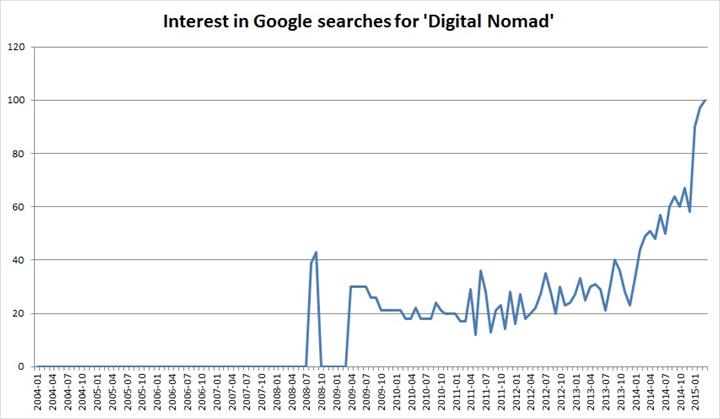
New services for digital nomads is such as blogs, foras etc. pop up all the time. This is really becoming normal and I only see this trend continuing in the future. We already mentioned some of the reasons why people are changing to this livestyle, but another one is that more and more people are working freelance or working multiple smaller jobs. In the US one in three is freelancing, which is completely changing the way we work and it will also change how companies recruit.
The rise of digital nomads: One out of three in the US is freelancing and how we work, travel and live is changing. CLICK TO TWEET
Could big companies have digital nomad programs?
With work changing, old school companies will be challenged. Before talent could be recruited and retained by salary and titles, but with digital nomads and freelancing becoming the new normal, more and more will not be satisfied with just money or a title. Their work has to be meaningful and it has to be on their own terms.
There are already popping up startups that runs completely with remote teams having employees spread over a lot of different countries and time zones. But will the same happen in old school companies?
I hope and think that some companies will start offering digital nomad programs of some kind. My idea is that it could be implemented in the agreement between the company and the employee, that the employee could work remotely for example 3 months per year. This would give the employee a chance of living and traveling in a way that 3-4-5 weeks of vacation could never do. At the same time the company would have an competitive edge towards attracting the best talents. Who knows, maybe they would even get more productive employees making better results for the company.
Could big companies have digital nomad programs? CLICK TO TWEET
Post-materialism will not happen anytime soon, but could happen sooner than we expect
The thought about post-materialism, a new time where money and material values are a thing of the past, is extremely difficult to imagine. Bu if we look back the shift from a world based on agricultural work and knowledge to the industrial world and again to a society focused on knowledge og technology went extremely fast and we don’t have to look that many years back in the history books. When considering that and that development is happening faster and faster, post-materialism could happen sooner than we expect.
But this is actually not really about a complete change of our world, but about a good change in the way we see work and life in general. Digital nomads are for me a sign, that people are valuing living a life that they define more and more. And I think that’s the way to become really happy. To define how you want to live life.
In all modesty, I think Refuga is an example of this. I could have done projects or work for clients that would pay a lot more. I could build other startups that had better business models. But Refuga makes sense for me and it gives me much more than money. It gives me a life where I can travel wherever I want whenever I want and I get to meet some extremely cool people.
I couldn’t be more positive about the time we are living in now and the future ahead of us.
Are digital nomads one of the first signs of post-materialism? CLICK TO TWEET

22. March 2015 | Blog
This article is written by Steffen Hedebrandt. Steffen is a Country Manager at Elance-oDesk in Scandinavia who joined our trip in 2014 to Kilimanjaro. He wrote an excellent piece about his experience on the trip for is blog on the website of Denmark’s biggest business media, Borsen. We have translated the piece and we’re really happy to bring it here on the Refuga blog. The piece was very well-written in danish, so we hope we get the feel of piece in english also. Don’t forget to check out Steffen’s personal blog (in english) right here.
Steffen will be joining our trip to Elbrus in July. We hope he will write an excellent post like this after that trip too. There is still time to sign up for Refuga Elbrus. Check it out here.
—
Lessons from Kilimanjaro
The concept was simple. Take a group of interesting people. Place them in amazing surroundings. Complete a big challenge with them. That was the description for Refuga Kilimanjaro.
The group consisted of creative Danish entrepreneurs. It all took place in Tanzania. The challenge was to climb the highest mountain of Africa, Kilimanjaro.
The result was 10 days with memories for life and a huge amount of inspiration for future work and projects.
With the backpack stuffed with everything from pills against Malaria and altitude sickness to a safari uniform, the 13 Danes flew from Copenhagen to Kilimanjaro Airport.
We experienced it all. From 30 degress celcius at the bottom of the mountain to -20 degrees at the top. From light rain to a snow storm.
Lesson from Kilimanjaro – What I learned from climbing Kilimanjaro with other entrepreneurs. CLICK TO TWEET

Up Kilimanjaro
The trip up and down again of Kilimanjaro is undoubtedly unique. It’s a challenge and a personal journey for each participant. Our trip on the mountain was 7 days. Five and half days up and one and a half day down.
For every day that went by, we saw new sides of Kilimanjaro. The first day was jungle. Huge trees as far as we could see. A crazy humidity. On the second day the jungle ended. From here the vegetations were only around the height of us. We ended the day over the clouds, where just small bushes and grass grow. A scenery taken from a fairytale. From here we could see the top. Four kilometers down was the bottom of Kilimanjaro.
It was this night, where Brian had to be evacuated. During the night he had left his tent to visit the toilet. The next thing he remembers is regaining consciousness laying on the ground. His face against a rock. There was no doubt. He had been hit by the altitude and had fainted. He had to be evacuated. 10 African people from the crew and two of the participants helped him 1,5 hour down the mountain to an emergency road. Here he and one of the guides were picked up by an emergency car, driving them to the nearest hospital.
A bad accident, but the journey continued. That was also what Brian wanted.
On the third and fourth day the vegetation slowly disappeared. Our bodies, our minds and our group slowly got use to the thin air. The fifth and last day heading up to basecamp, placed just before the last, very steep part, offered us a windy desert-like landscape.
For every step here, you climb out. For every step the air gets thinner. You have to walk slowly. “Pole pole” as Yoda-look-a-like our guide-in-charge, Mr. Minja kept saying again and again. Mr. Minja is a legend on the mountain. All other guides and staff know and greet him on the mountain. You can understand why, when he said he had been to the top between 6-800 times. He didn’t speak much, but when he did, we listened.
You experience that some days you’re strong. Other days you need the help from your team mates. Some times you need energy. Other times more water. A pill against the altitude sickness. A raincover. A hand. A smile.
To the top – Through darkness, thunder and lightning
On the last day, the summit day, we we’re woken up at 11pm after just a few hours, if any, sleep. The basecamp had the day before been filled with sunshine and a light wind, but that had changed completely. Lightning and the following thunder was our new surroundings. And it was close. You could just count a few seconds between lightning and thunder. But that was not all. When we opened our tents, we could see a layer of snow covering everything. And more was coming. There was snow, wind, lightning and thunder coming down over the dark mountain.
The hopelessness of the situation was a mental challenge for us all. Optimism, chatting and smiles could still be found in the big tent where we met for one last briefing before departure at midnight. I’ll admit that I had a good amount of scepticism at that time. The nature surrounding us was in a crazy mood. It made me focused. Concentrated. Determinated. Others had energy to joke. I didn’t. We had gotten so far. We we’re so close.
Out we went
On one line. One guide in front. 12 Danish entrepreneurs in the middle. 3 guides in the back. Up, forward, up. Through endless darkness. Pole pole. Break. Snow. Thunder. Energybar. Frozen drinking bottles. Up. Darkness. forward. Pole pole. Endless darkness.
That’s how it went.
Up. No idea about where we had started. No idea about how long was left. A six hours long hike. In darkness. Towards Stella Point. The point where Kilimanjaro’s plateau is reached and the climb decreases.
At the exact moment, where the first sunshine of the day hit Africa, we reached Stella Point. It was the culmination. A liberating feeling. A moment of joy. It was overwhelming. Some were hit hard by the altitude. Others were extremely tired after the 6 hour marathon in darkness. The emotions were difficult to control. Tears in the eyes. We all admitted that. We saw the sun rise over Africa.
Not at the finish line yet
The absolute top, the top of the plateau is called Uhuru Peak and it’s 5.895 meters above sea level. There were still 45 minutes walk to that point. Everybody was hurting. But this stretch was easier. Over the plateau. With the clouds under us. Gletchers on both sides. And the sun rose higher on the sky. Now we could see where we were going. We could see Uhuru Peak.
We made it. We raised our arms. Cracked big smiles. Hugged each other. Took the mandatory pictures. Enjoyed the moment. Reached the finish line. Our goal. The top of Africa.
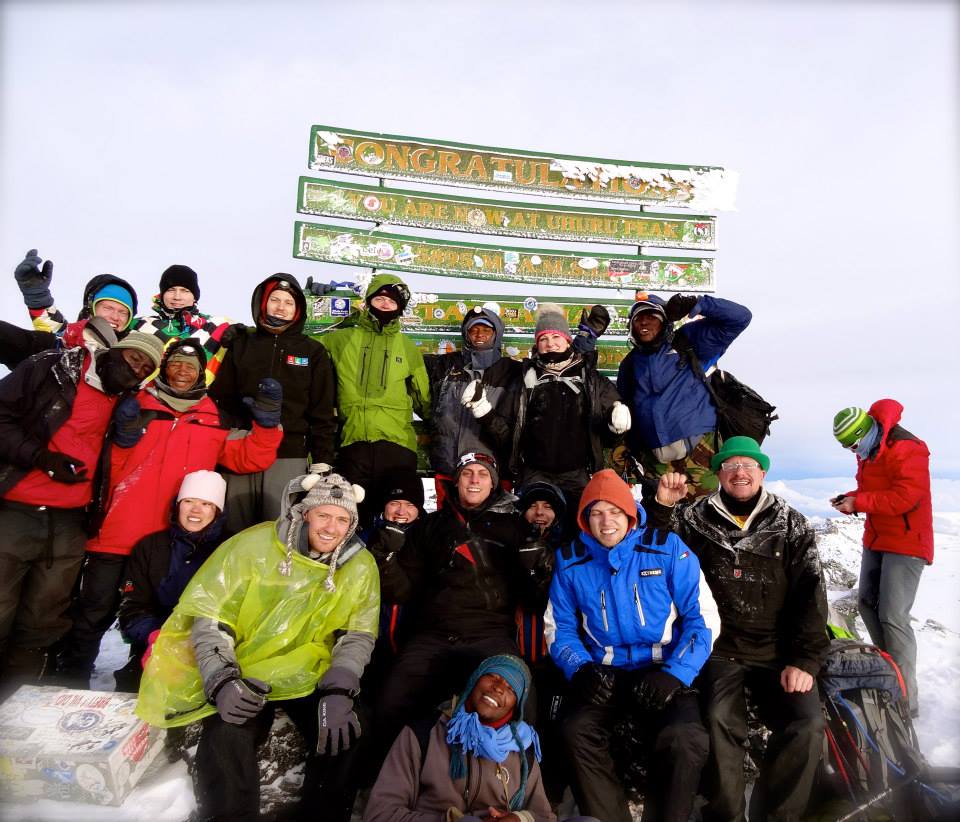
Kilimanjaro is a tough physical test. But it’s possible for everyone in a reasonable shape. Mentally, you also have to be strong. But you won’t make it without good team mates. We all had 12 of those.
The talks. The sharing of ideas. The sharing of emotions. The helpfulness of the others was big. The inspiration was enormous. Every day.
The learnings and value of a trip like this, as individuals and as a group, is impossible to describe in words.
We all reached some conclusions from the trips. Some lessons learned.
Bye bye comfort zone
If you want develop, it’s important to challenge and push yourself. For example by climbing a mountain. It can also be other things.
You have to be willing to step out of your comfort zone. Pushing your limits. Accomplish something that is at the edge of your capabilities. That is something that gives you energy. To be in a tough situation and to have completed it. Energy that can be used in busy day to day life.
Forgetting the trivialities of the everyday
The combination of being in nature for a week, moving from A to B every day, often during many hours, towards the same goal. That lays the foundation for incredible conversations.
Suddenly, all the noise of our normal lives is gone. No push notifications, no e-mails and no phone calling. If you have food and water the only other important thing, is the content of the conversation you are having.
These clean and undisturbed conversations removes the facade that can normally be found in everyday conversations. The facade that makes you answer “fine, thanks”, when asked how you’re doing. Even though you might be in a situation where you partner just left you, a family member is sick, your business is having a hard time or if you are lacking direction and meaning in your life.
These conversations are mental bootcamps. It’s like a cleaning. You sort things. You arrive back home with more balanced thoughts about yourself, your friends and your colleagues.
Now and here
Focus on the task right in front of you. That was a lesson repeated a lot of times on Kilimanjaro. Busy people, planning and execution-specialists, is what a lot of us are and we want to know what’s the step after the next step.
When asking our African guides, we always got the same answer. Focus on the next thing. Not what’s after it. Don’t overthink. It’s too much to comprehend. Let’s start with the task in front of us. Then we will tackle the next thing when it’s there.
Both in life, when doing projects and in entrepreneurship in general, being present is crucial to solving the situation in the best way possible.
Gratitude
One of the trips most overwhelming experiences was saying goodbye to our African helpers. We had over 50 of them. Cooks, carriers, guides. Every day they moved our camp from one place to another. With 20 kilos on their backs, they went before us. To set up the camp. To get water. To purify the water. To cook. Morning. Midday. Evening.
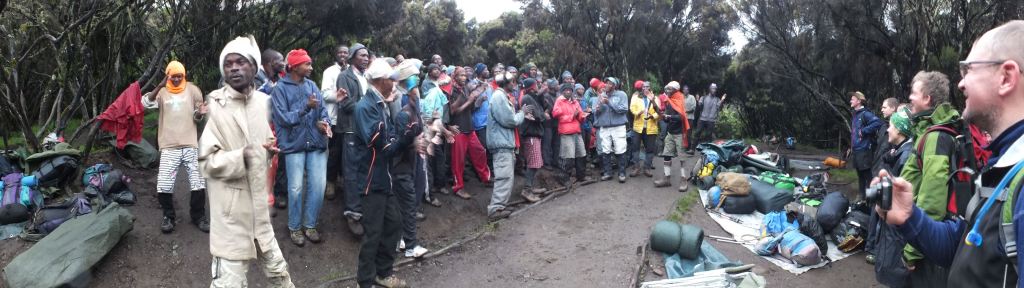
When we were about to say goodbye and thank them for their help, they all gathered. We thought that we were going to shake their hands. To say thanks. Instead they bursted out in singing. They sang and danced to a song about Kilimanjaro. How great it was, that we had taken the trip. Our payments for a weeks work, would last for 3 weeks of food.
We were all overwhelmed. Almost a bit embarrassed. They thank us. We should thank them. What a level of gratitude. Of working. Of being together. Of the moment.
Lesson from Kilimanjaro – What I learned from climbing Kilimanjaro with other entrepreneurs. CLICK TO TWEET
This post was written by Steffen Hedebrand, a Country Manager at Elance. Steffen will also be joining our trip to Elbrus – The highest mountain of Europe in July 2015. You can join him. Check out Refuga Elbrus here.

6. March 2015 | Blog
Update 10th of April 2015: This opening is closed. We’re currently going through the applications!
We want to invest in building our community bigger, by providing something of value to all entrepreneurial minds out there. That’s why, we are super happy to announce that we are hiring a full time Content Marketing Manager in the Refuga team.
If you want to work and live wherever you feel like and if you want to help us take Refuga from a small project to a real business… well, then we might just have the opportunity for you!
Want to create awesome content and work wherever you want? @refugacamp has the job for you. CLICK TO TWEET
A bit about the job:
With this position you will be overall responsible for content at Refuga, with a focus on our blog, but also including other marketing tasks. The job can also consist of others areas where content is needed (news letters, social media, content for other sites, etc.). The job is location independent. That means no office. You can be based where you want and travel around (we do). Depending on where you will be working from, we will agree on the hours you are online and working.
The job will contain the following areas:
- Researching for new content
- Doing interviews
- Collecting data
- Writing posts
- Putting together graphics for the posts
- Marketing of each posts
- Work will include doing posts completely from a-z, but sometimes also finishing and editing other people’s posts.
- Approx. one day per week will be focused on outreach, working with bloggers and media (including establishing contact, communication and providing them with content)
The topics are aimed at all entrepreneurial minds and will be in the following three areas:
- Insights into the Refuga journey
- Resources on growing you company
- Experiments in getting most out of life
Who we are looking for:
We are hiring the right person, so feel free to apply. Here are some of the areas we will be looking at:
- Have a really high sense of quality. The content we will publish is going to be the best within it’s field.
- You have to have experience curating high quality content.
- Be productive. We are a startup, so we work fast and get things done, so should you.
- Be absolutely fluent in English.
- Be proactive. We want someone with ideas.
- Someone that doesn’t like being micro managed. You have to be able to make things happen your self.
- Of course you have to dig the concept of Refuga. We couldn’t imagine anyone not digging it :), but this is not just a job, but something you should be proud of and passionate about. We are and we want to build a team that has the same spirit.
In general we are looking for someone who wants responsibility and a great chance. The perfect candidate could be someone with the dream of starting up their own company in the future and a job at Refuga could be the next step towards that.
How will it work?
We are a location independent project and, due to the nature of the project, we often travel. This also means that this job is location independent, meaning that you can work from where you like.
We communicate daily using Trello and Skype.
We are a company that works with processes. This means that every recurrent task we have in the company is associated with a process – a specific way we do that exact tasks. We document everything via Trello, so we can work without any problems even though we run things remotely.
You will be part of a project that has been going on since 2012 and since the end of 2014 as a full-time project. The team consist of 5 people; the two owners, two assistents and one developer. You will be the first full-time employee in the project (YEAAAH).
What do I get paid?
The pay is set at $2.000 per month.
You also get
- Full access to the two owners, including feedback on your own project
- One yearly Refuga trip where we will also be
- Access to the Refuga network
We know the salary isn’t much. This job is perfect for someone who is living or want to live as a digital nomad or is permanently living some where cheap. We travel around ourselves, living on a smaller budget than we would back in Denmark.
How do I apply?
Update 10th of April 2015: This opening is closed. We’re currently going through the applications!
First of all, you have to be 100% clear if this job is something for you. Think about both the pay and that you will be location independent.
We get a lot of emails each week, so please only apply for this job if you are serious, have the qualifications and want to start asap.
If you have read all of this and it sounds like the chance of a lifetime, then don’t hesitate to apply, by sending your information (including CV and motivation for working with Refuga) to Nikolaj Astrup at hello@refuga.com.
We will pick a few persons out who will be doing a piece of content that we will evaluate. You will of course get paid for the test, no matter if we end up working together or not.
Apply for the Content Marketing Manager job at @refugacom and work wherever you want. CLICK TO TWEET

12. January 2015 | Blog
It’s January and we are at the very beginning of a new, exciting year. This beginning of the year also marks the first 3 months, that I have worked full-time on Refuga, which I’m super happy about. I love transparent companies, so I want to share a bit of our numbers and tell a bit about what we are working on right now. Let’s called it Refuga Insight 🙂
Right now I’m (Nikolaj, the founder of Refuga) is working from beautiful Morocco. I’m writing this from a roof top in a small city by the coast while the local mosque is calling for prayers. The picture in the top is from the roof top some days ago.
Building a travel agency for entrepreneurs. Read the insights after 3 months full time. CLICK TO TWEET
How many people actually work with the Refuga project?
I get this question now and so often. Refuga is owned by me, Nikolaj. I founded the project back in 2012 and went from only doing trips for danish entrepreneurs to also having an international focus last year.
I like to run Refuga very lean and flexible. That means no office and no full time employees. I have 4 people spread over the world, that works with me on the project, from developers and assistent. In total it sums up to 2 full time employees.
I use assistents for both planning and the work with marketing and other practical stuff. The people working with Refuga is located in India, Morocco, Kenya and Russia. Myself, I move a bit around. I’m from Denmark, has just lived for 5 months in Barcelona and currently I’m in Morocco.
What is the best thing that has been accomplished the last 3 months at Refuga?
I actually didn’t start to work fulltime on Refuga since late September 2014. Before that it was just a hobby project. A hobby project I was very passionate about. I’ve always seen myself as good as seeing oppourtinities and being positive about that, but I must admit it took me quite some time to believe I could do this full time. Now I’m here and the feeling is incredible.
That also means that I have only been working professionally with growing Refuga for around 3 months. Looking back on those months, I’m quite happy about what has been accomplished.
The focus has been marketing. I know that people like the Refuga trips. So far 40% of all participants has been on 2 or more Refuga trips. That’s something I’m really happy for. But If Refuga has to grow, I needed to find the right marketing channels for it. That has been the biggest task and accomplishment the last 3 months. My background is in online marketing, so it has been a task that I really enjoyed.
In those 3 months I have worked a lot with social media, focusing a bunch on Twitter and Instagram. Both has been incredible channels for Refuga. I’ve spent a lot of time on getting things right with these channels. I also spent a lot of hours working with Facebook Ads and after some time I got it tweaked, so I now exactly how to spread Refuga really cheap to new people in new countries.
Getting email newsletter signups is also something that is really important. I’ve worked a bunch on that with a good result. Before we got around 8-10 per week and now we get around 60-80. Both numbers are for periods where we don’t spend any money on marketing. When running really targeted and optimized Facebook Ads and other initatives, the number is of course higher.
I will come back to the marketing part later.
I’m also really happy that we had a great first trip to Barcelona with an international group in October 2014 and that the second trip to Italy in May 2015 sold out super fast.
What is the biggest challenge for Refuga right now?
So a bunch of good things is going on, but it’s not all fairytales and umbrella cocktails. Of course there is challenges.
The absolute biggest challenge for Refuga is time. I have come a long way with finding a good setup, concept and tweaking different marketing channels. I’ve something that works, but I need more time. So the solution is of course to hire people, but this is probably the real challenges. I need to learn to give things to others and not do everything myself.
So right now, the biggest challenge for Refuga, is myself. And that is actually a great feeling. I have everything to make this happen, it’s just up to myself.
I hope to give a positive update on this in the future 🙂
What we are working on right now and the near future
The overall focus right now is doing our own trips. That is the base of Refuga, so the focus is to do a bunch of trips in 2015 and of course sell the spots for those.
Around that we are trying to build the processes, so everything can be done really smooth and so it’s possible to scale. I’m sure we can make 100 incredible Refuga trips per year, but it requires a fundation that works and that is what we are doing right now.
Building the foundation means finding the right marketing channels, finding the right people and setting up processes for each little thing. This takes time. In 2012 we did the first trip. In 2013 we had 2 trips and last year we had 4 trips and we will be aiming at doubling that this year too.
This might seem like very slow growth and it is, but when considering that this has only been a full time project for around 3 months, I’m pretty happy about it. 2015 will be the year where the fundation get tested and improved, so growth can be faster.
Could we actually make Refuga “open source”?
One of the things we are working a bit on right now, is a way to open up for Refuga. Inspired by the open source movement, I’ve been thinking about ways to let other people arrange Refuga trips without the hasle.
It seems like more and more people are arranging retreats and trips like Refuga do and more and more people want to go on trips like this. Could we actually use the last couple of years of experiences to make a platform where other people can easily arrange and spread the word about trips?
That’s the idea behind this landing page, which we haven’t made a lot of noise about. If you applied and haven’t received an answer, don’t worry. We will get back to you. We received a lot of applications and we are going through them.
Is it possible to build an open source travel agency for entrepreneurs? @refugacom is trying. CLICK TO TWEET
Right now we will be using this landing page and the applications to gain experiences and hopefully arrange the first trips with other organizers. These experiences will hopefully result in us doing some kind of platform where people with big networks or communities can arrange trips themselves.
It should be possible for a german SEO expert with a big personal brand to easily do a Refuga trip, where he get’s a bunch of people to a beautiful location and teach them SEO. It should be possible for small startup media sites to arrange their own trips and earn money on it, without the hassle or risk.
Refuga Insight… Trying to be transparent
I really, really like transparent companies, projects and founders and “Refuga Insight” is me trying to open up and tell a bit about the project. As you might have noticied this blog hasn’t really been so active. I don’t have a content strategy and I don’t prioritize this blog at all, but when I feel there is something to share I will.
If the response to these kind of posts is good, I will absolutely try to prioritize it a bit more and tell more about the ups and downs of the Refuga project.
Thanks for reading and thanks for your interest in Refuga. I really, really appreciate it.

Recent Comments